
- Digital Marketing
- SEO
What are Google Algorithms & How Do Google Algorithms Work?
What Google algorithms are, how ranking systems work, and what changed from 2024 to 2026: helpful content in core, new spam policies and AI Overviews.
 AuthorRehmat Ullah7 min readUpdated
Table of Contents
Google algorithms decide which pages appear for a search and in what order. They sit behind every result you see, from a Daraz product page to a local clinic in Mardan.
If you do SEO or run a business website, you need a working picture of these systems. This guide explains what Google algorithms are, how they work, and what has changed since 2024, including new spam policies and AI Overviews.
What are Google Algorithms?
1. Definition:
- Google algorithms are automated systems that pull pages from Google's search index and rank them for a query. Google now calls them "ranking systems". Some run on every search; others handle narrow jobs such as spotting spam or removing duplicate results.
- Google publishes a guide to its ranking systems that lists which systems are active and which have been retired.
2. Key Google Algorithms:
- Panda: Focused on content quality. Launched in 2011, it became part of Google's core ranking systems in 2015, so it no longer runs as a separate update.
- Penguin: Targeted manipulative links. It was folded into core ranking in 2016.
- Hummingbird: A 2013 overhaul that improved how Google handles natural language queries. Google lists it as retired, with its work carried on by newer systems.
- RankBrain: A machine learning system that helps Google understand how words relate to concepts, so it can return useful pages even when they don't contain the exact words searched.
- BERT: An AI system that reads words in context, so small words like "for" or "to" can change what Google thinks you mean.
- Neural matching and MUM: AI systems that match the concepts in a query to the concepts on a page. Google says MUM is used for specific tasks rather than general ranking.
- Link analysis and PageRank: Systems that look at how pages link to each other to understand what pages are about and which may be most helpful.
- Reviews system: Rewards reviews that show original analysis and first-hand research over thin summaries.
- SpamBrain: Google's spam detection systems, which include SpamBrain, find content and behavior that breaks Google's spam policies.
- Mobile-First Indexing: Google mainly uses the mobile version of a page's content for indexing and ranking. A page that is thin or broken on mobile is judged on that version. See Google's mobile-first indexing guide.
How Do Google Algorithms Work?
1. Crawling and Indexing: Google's crawler, Googlebot, follows links and sitemaps to find new and updated pages. Pages it can process are stored in the index, a huge database of the web.
2. Analyzing Content: Ranking systems check what a page is about and how well it matches a query. They look at the words used, headings, freshness, and how clearly the page answers the question.
3. Evaluating Page Quality: Google tries to reward helpful, reliable content made for people. Signals include links from other sites, original information, and whether the page shows real expertise and experience.
4. Understanding User Intent: Systems like RankBrain, BERT and neural matching work out what the searcher actually wants. "Best laptop under PKR 150,000" needs a comparison, not a manufacturer's home page.
5. Ranking and Displaying Results: Google combines these signals and orders the results. The page may also show ads, a local pack, videos, or an AI Overview above the regular links.
What Changed Since 2024
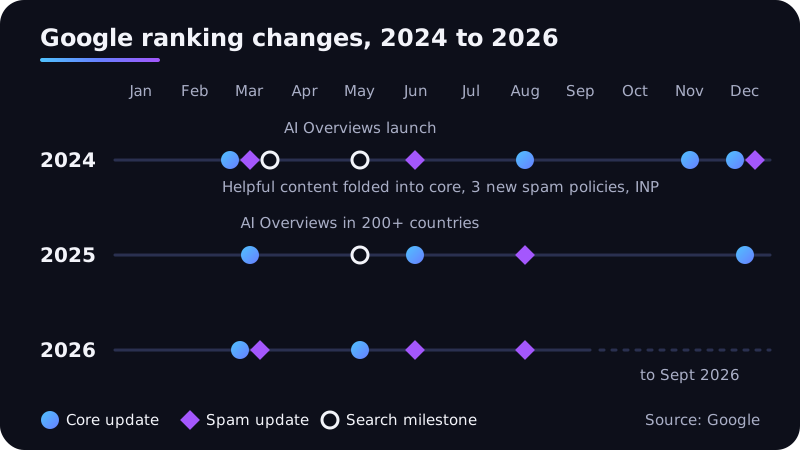
Google makes changes to search all the time. A few big ones since early 2024 changed how SEO works. The timeline below shows the major announced updates.
1. The helpful content system is now part of core ranking:
- The helpful content system launched in 2022 to demote content written mainly for search engines. With the March 2024 core update, Google folded it into its core ranking systems.
- There is no longer a separate "helpful content update" to wait for. Helpfulness is judged continuously, as part of normal ranking.
2. Three new spam policies (March 2024):
- Scaled content abuse: Producing many pages mainly to manipulate rankings, whether by AI, scraping or hand. Google's policy names "using generative AI tools or other similar tools to generate many pages without adding value" as an example.
- Site reputation abuse: Publishing third-party content on a trusted site mainly to borrow that site's ranking signals.
- Expired domain abuse: Buying an expired domain and reusing it mainly to rank low-value content on its old reputation.
Read more in our guide to black hat SEO.
3. Core and spam updates since 2024:
- Core updates: March, August, November and December 2024; March, June and December 2025; March and May 2026.
- Spam updates: March, June and December 2024; August 2025; March, June and August 2026.
- All dates come from the Google Search Status Dashboard. It is the place to check when rankings suddenly move.
4. INP became a Core Web Vital:
- On 12 March 2024, Interaction to Next Paint (INP) replaced First Input Delay as a Core Web Vital. INP measures how quickly a page responds when someone taps, clicks or types. Learn more in what are Core Web Vitals.
AI Overviews and AI Mode
AI Overviews are AI-generated summaries that appear above the regular results for some searches, with links to the pages they draw from. Google launched them in May 2024.
Since May 2025 they have been available in 200+ countries and territories and 40+ languages, including Urdu. AI Mode, a chat-style search experience, is also available in Pakistan with Urdu support.
For site owners, the basics stay the same. AI features still draw on Google's index, so pages need to be crawlable, clear and trustworthy. Answer questions directly, keep facts accurate, and show who wrote the content and why they know the topic.
Importance of Google Algorithms
1. Ensuring Relevant Results: Ranking systems aim to show the most relevant and useful results, so people find answers quickly.
2. Maintaining Search Quality: Regular core and spam updates push down spammy, copied and low-value content, which gives honest sites a fairer chance.
3. Influencing SEO Strategies: Knowing how the systems work helps you plan content and fix problems. When a core update lands, you can compare your pages against what Google says it rewards instead of guessing.
4. Enhancing User Experience: Google's page experience guidance, including Core Web Vitals, encourages fast, stable, mobile-friendly pages. These help visitors even where their direct ranking effect is small.
Best Practices for Navigating Google Algorithms
1. Focus on Quality Content: Write for people first. Add original insight, examples and first-hand experience. Avoid keyword stuffing and pages that only rewrite what already ranks.
2. Build Quality Backlinks: Earn links from relevant, reputable sites. Mark paid or sponsored links with rel="sponsored" and avoid link schemes.
3. Optimize for User Intent: Check what already ranks for your target query. Match the format people expect, such as a guide, product page or local listing.
4. Ensure Mobile Friendliness: Many of your visitors will arrive on a phone. Make sure your mobile page has the same content as desktop and loads quickly on mobile data.
5. Use AI Carefully: Google's guidance on generative AI content says helpful AI-assisted content is fine, but using automation mainly to manipulate rankings is spam. Edit, fact-check and add your own expertise.
6. Stay Updated on Algorithm Changes: Watch the Search Status Dashboard and Google Search Central Blog. After an update, wait for the rollout to finish before judging the impact.
Conclusion on What are Google Algorithms & How Do Google Algorithms Work
Google algorithms decide how search results are chosen and ranked. Since 2024, helpfulness has become part of core ranking, spam policies have widened, and AI Overviews have changed the look of the results page.
The winning approach hasn't changed: build helpful, trustworthy pages for real people, keep your site technically sound, and follow Google's policies.
Stay Ahead with Expert SEO Strategies
Worried about the next core update? Softhat IT Solutions audits sites against Google's current guidance and builds content and link plans that hold up over time. Explore our SEO services, or book a free strategy call to talk through your site.