- Content Writing
How to Write Website Copy That Turns Visitors Into Leads
Learn how to write website copy that converts: research your buyer, write outcome-led headlines, structure pages for scanners and add proof and clear CTAs.
 AuthorRehmat Ullah8 min read
Table of Contents
Your website gets visitors. Some of them even stay for a minute. Then they leave without calling, messaging or filling in the form.
In most cases the design is not the problem. The words are. This guide shows you how to write website copy that converts: copy that tells the right visitor, in seconds, what you do, why it matters to them and what to do next.
It is written for Pakistani business owners and marketers who write their own pages or brief a writer. No theory for its own sake, just a process you can apply to your homepage, service pages and landing pages this week.
Why most website copy fails to convert
Visitors do not read your pages the way you wrote them. In a well-known study, Nielsen Norman Group found that 79% of test users scanned any new page, and only 16% read word-by-word.
A later analysis estimated that on an average page, users have time to read at most 28% of the words, and 20% is more likely. So most of your copy will never be read. The parts that are read must do the heavy lifting.
The original study also tested rewrites of the same page. Concise text scored 58% better on usability, scannable layout 47% better and objective (non-promotional) language 27% better. All three together scored 124% better. In practice, most underperforming pages share the same problems:
- They talk about the company, not the customer. "Founded in 2015, we are a leading provider..." answers a question nobody asked.
- They hide the offer. The visitor has to scroll three screens to learn what you actually sell.
- They use claims instead of proof. "Quality service" and "affordable prices" appear on every competitor's site too.
- They end without a clear next step. Or they offer five next steps at once.
Step 1: Know exactly who you are writing for
Good copy starts before you write a word. You need to know one visitor well enough to predict their questions and doubts.
If you have not done this yet, start with our guide on how to craft powerful buyer personas. Then collect the words your customers already use:
- Read your WhatsApp and inbox history. Note the exact questions people ask before they buy.
- Listen to sales calls. Write down objections: price, timing, trust, "will this work for my industry?"
- Read reviews, yours and your competitors'. Praise tells you what people value. Complaints tell you what they fear.
- Check search queries in Google Search Console to see how people describe the problem.
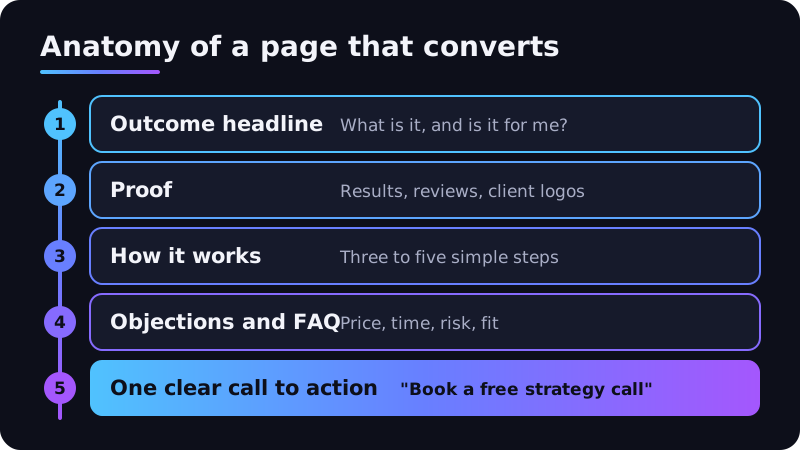
Build a simple message map from this research:
| Question the visitor has | Where the page answers it |
|---|---|
| What do you offer, and is it for me? | Headline and sub-headline |
| Why should I believe you? | Proof section: results, reviews, client logos |
| How does it work? | Three to five step process |
| What will it cost me (money, time, effort)? | Pricing or "what affects the price" block |
| What if it doesn't work out? | FAQ, guarantees, terms |
| What do I do now? | One primary call to action (CTA) |
Step 2: Write a headline that states the outcome
Your headline has one job: tell the right person what they get. Clever wordplay usually loses to plain clarity, because scanners only read the first few words.
A reliable structure is outcome + for whom + how. Compare these:
| Weak headline | Stronger headline |
|---|---|
| Welcome to ABC Solar | Cut your electricity bill with solar systems installed across KPK and Punjab |
| Your trusted IT partner | Custom software for Pakistani SMEs, delivered in fixed-scope sprints |
| Excellence in education | Pass your IELTS with small-batch evening classes and weekly mock tests |
Then use the sub-headline to add the "how" or remove the biggest doubt: a timeframe, a guarantee you can actually honour, or who you already serve.
Rules for headlines:
- Lead with the benefit, not your brand name.
- Use the words your customers use, not internal jargon.
- Keep it specific. If you have a real number, use it. If you don't, use a concrete detail instead of an adjective.
- Never promise a result you cannot prove.
Step 3: Structure the page for scanners
Because people scan, structure matters as much as sentences. NN/g's eyetracking work describes the F-shaped reading pattern: users read across the top, then a shorter line lower down, then scan down the left side.
You don't need to design for a literal "F". You do need to put the most important words where eyes land: the start of headings, the first line of paragraphs and the left edge of lists.
Practical formatting rules:
- Inverted pyramid. Put the conclusion first, details after. Answer "what is it and is it for me?" above the fold.
- Descriptive subheadings. "How the installation works" beats "Our process". A scanner should understand the page from subheadings alone.
- Short paragraphs. Three lines or fewer on mobile. One idea per paragraph.
- Bullets for lists of features or deliverables. Bold the first few words so they scan.
- Front-load links and buttons with meaningful text: "See pricing factors", not "Click here".
Step 4: Replace claims with proof
Every business says it offers quality and good value. Visitors ignore those words. What moves them is evidence.
Google's own guidance on helpful, reliable, people-first content asks whether content "presents information in a way that makes you want to trust it". That is a good test for sales copy too. Our explainer on E-E-A-T covers how experience and trust signals work for search.
Types of proof, from strongest to weakest:
- Specific, verifiable results with the client's permission: "Reduced response time from 4 hours to 15 minutes."
- Case studies that show the problem, the approach and the outcome.
- Named testimonials with a photo, role and company.
- Client logos, certifications, partner badges and years in business.
- Process transparency: showing exactly how you work also builds trust when you are new.
Only use results you can back up. Invented or inflated numbers damage trust the moment a prospect asks for details.
Step 5: Make the call to action the obvious next step
A page should have one primary action. Secondary actions are fine, but they should not compete for attention.
Write CTAs that describe the result of clicking:
| Vague CTA | Specific CTA |
|---|---|
| Submit | Get my free quote |
| Click here | See how it works |
| Contact | Book a free strategy call |
| Learn more | Compare packages |
Match the commitment to the visitor's stage. A cold visitor from a blog post may not book a call, but might download a checklist or send a quick WhatsApp message. A visitor on a pricing page is ready for "Start a project".
Also reduce friction around the CTA:
- Ask only for the form fields you truly need.
- Say what happens next: "We reply within one working day."
- Offer the channel your customers already use. If most enquiries arrive on WhatsApp, put a WhatsApp button beside the form.
- Repeat the CTA after each major section on long pages.
Step 6: Edit, measure and improve
First drafts are for getting ideas down. Conversion comes from editing. Run every page through this checklist before publishing:
- Can a stranger explain what you offer after reading only the headline and sub-headline?
- Does every section answer a real customer question?
- Have you cut words like "leading", "best-in-class" and "one-stop solution"?
- Is every claim backed by proof or removed?
- Is there one primary CTA, repeated where needed?
- Does the page read well on a phone screen?
- Is the reading level simple enough for a busy owner reading between meetings?
Then measure. In Google Analytics 4, mark form submissions, calls and WhatsApp clicks as key events (GA4's current name for conversions). Compare conversion rates before and after each major copy change.
Change one element at a time when you can, such as the headline or the CTA. Otherwise you won't know what caused the difference.
Common questions about website copy
How long should website copy be?
As long as it takes to answer the visitor's questions, and no longer. A simple, low-cost offer can convert with a short page. A high-value service usually needs more proof, process detail and FAQs, because the buyer's risk is higher.
Should website copy be written for SEO or for people?
For people first. Google says its systems aim to reward content that is created primarily to help people. Use the phrases your customers search for naturally in headings and body text, but never at the cost of clarity. See why content is important for SEO for how the two work together.
Can I use AI tools to write my website copy?
AI tools can help with outlines and first drafts. But they don't know your customers, your proof or your pricing. Always edit for accuracy, add real examples and make sure the result sounds like your business.
How often should I update my website copy?
Review key pages at least when your offer, pricing or audience changes. Also review them when analytics shows a page gets traffic but few leads.
Turn your website into a lead source
Converting copy is not about clever words. It's about understanding one visitor, answering their questions in order, proving your claims and making the next step easy.
If you would rather have specialists research, write and test your pages, our content writing team writes website copy for businesses across Pakistan, from Karachi to KPK. Book a free strategy call and we'll review your current homepage copy with you.