- E-commerce
- Web Development
WordPress vs Shopify vs a Custom Website: Which Should You Choose?
WordPress vs Shopify vs a custom website: compare cost, control, payments, SEO and upkeep to pick the right platform for your Pakistani business.
 AuthorRehmat Ullah7 min read
Table of Contents
Choosing a platform is one of the first decisions in any website project, and one of the hardest to undo. Pick wrong and you may rebuild within two years.
The WordPress vs Shopify vs custom website debate has no universal winner. Each option is excellent for some businesses and a poor fit for others. The right choice depends on what you sell, how much control you need, who will manage the site and how you take payments in Pakistan.
This guide compares the three options side by side, then gives you a simple way to decide.
The three options at a glance
WordPress is free, open-source software you install on your own hosting. It powers about 40% of all websites, according to W3Techs. Add the free WooCommerce plugin and it becomes an online store.
Shopify is a hosted e-commerce platform. You pay a monthly subscription, and Shopify handles the hosting, security updates and checkout infrastructure.
A custom website is built by developers with a framework such as Next.js, Laravel or Django. There is no licence fee, but you pay for design, development, hosting and ongoing developer support.
| WordPress | Shopify | Custom website | |
|---|---|---|---|
| Best for | Content sites, company sites, small to mid stores | Product-focused online stores | Web apps, portals, unusual workflows, high scale |
| Upfront build | Low to medium | Low to medium | Medium to high |
| Recurring costs | Hosting, premium plugins and themes, maintenance | Subscription, apps, transaction fees | Hosting, developer retainer |
| Hosting and security | Your responsibility (or your host's) | Handled by Shopify | Your responsibility (or your developer's) |
| Flexibility | High, via plugins and code | Medium, within Shopify's rules | Total |
| Ease of editing | Good | Very good for products | Depends on the admin built for you |
| Local payment gateways | Many plugins available | Third-party providers only | Any gateway with an API |
WordPress: flexible and content-friendly
WordPress started as blogging software and grew into a general-purpose CMS (content management system). It is released under the GPL, which gives you the freedom to run, study, change and redistribute the software.
Where WordPress shines
- Content and SEO. Pages, blog posts, categories and SEO plugins are mature. If content marketing is central to your plan, WordPress is a natural fit. See our guide on how to start a blog.
- Huge ecosystem. Thousands of themes and plugins, and plenty of developers in Pakistan who know it well.
- Ownership. You own the files and database and can move hosts whenever you like.
- Local payments. Pakistani gateways, including Easypaisa, offer or support WooCommerce plugins.
Where WordPress struggles
- Maintenance is on you. Core, theme and plugin updates, backups and security hardening are ongoing work.
- Plugin sprawl. Every plugin adds code, possible conflicts and a potential security hole. Sites with 40 plugins are often slow.
- Performance takes effort. Speed depends on hosting, theme quality and caching. Page speed matters for SEO and sales, as we explain in how important page speed is for SEO.
Shopify: fastest route to a working store
Shopify is built for selling. Products, inventory, checkout, discounts, shipping rules and order management work out of the box.
Where Shopify shines
- Less technical work. Shopify hosts the store, applies platform updates and provides free SSL for your domain.
- Payment security. Shopify says it is certified Level 1 PCI DSS compliant, and that this covers stores on the platform. PCI DSS is the card industry's security standard.
- App store. Reviews, upsells, email marketing and courier integrations can be added without custom code.
- Easy for teams. Staff can add products and process orders with little training.
What to check before choosing Shopify in Pakistan
- Shopify Payments is not available. Pakistan is not on Shopify's list of supported countries, so you use a third-party payment provider.
- Extra transaction fees. When Shopify Payments is not active, Shopify charges a third-party transaction fee on orders, on top of your gateway's own fee. The rate is lower on higher plans; check the current rates on the pricing page.
- Recurring costs grow. Subscription, paid apps and premium themes are billed in US dollars, so exchange rates affect your monthly bill.
- Less control. You work within Shopify's checkout and data structure. Unusual workflows can be hard or impossible.
Custom website: built around your business
A custom build means developers write the site for your specific needs. Modern custom sites often use a framework like Next.js for the front end, with a database and a simple admin panel.
Where custom shines
- Exact fit. Booking rules, dealer portals, quotation builders, multi-vendor logic: if you can define it, it can be built.
- Performance. With no unused plugins, a well-built custom site can be very fast.
- No licence fees. No per-order platform fee and no monthly subscription beyond hosting and services you choose.
- Integrations. Connect any gateway, courier, ERP or WhatsApp automation that offers an API.
Where custom struggles
- Higher upfront cost and longer timelines. Everything from the admin panel to SEO basics has to be built or configured.
- Dependence on developers. Choose a team that documents its work and hands over code and access.
- You own the upkeep. Security patches, dependency updates and hosting need a plan.
How each platform affects SEO, speed and payments
SEO. All three can rank well. Google does not favour a platform; it rewards useful content, clean structure and good page experience. WordPress makes content publishing easy. Shopify handles technical basics but has fixed URL patterns such as /products/ and /collections/. A custom site gives full control, but only if your developers build SEO features properly.
Speed. Shopify's hosting is fast by default, though heavy apps and themes slow stores down. WordPress speed depends on your host and plugin choices. Custom sites can be fastest, but only with good engineering. A content delivery network helps all three.
Payments. For Pakistani merchants, local gateways such as JazzCash, Easypaisa and bank gateways matter. WordPress and custom sites can integrate them directly without platform transaction fees. On Shopify, check that your chosen provider supports Shopify before you commit.
Budget. Upfront and running costs differ a lot between the three. We break down the cost drivers in how much a website costs in Pakistan.
Which should you choose? A simple decision guide
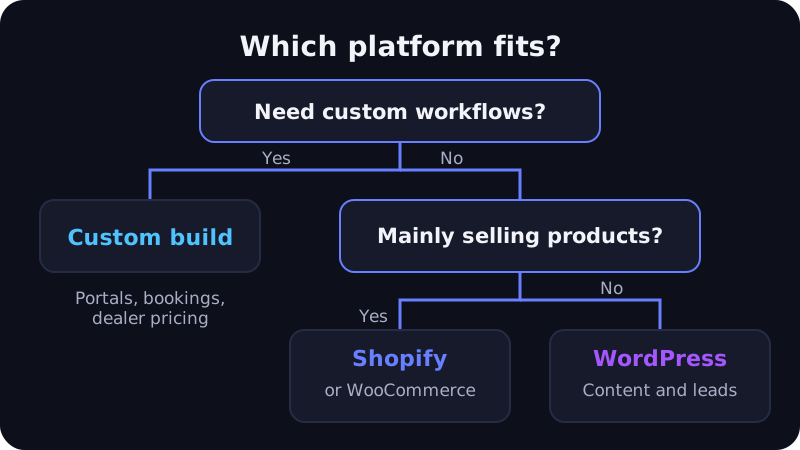
Answer these questions in order:
- Do you need features no off-the-shelf platform offers? Customer portals, complex booking or pricing rules, or deep integration with internal systems point to a custom build.
- Is selling products online the main purpose? If yes, and you want the least technical work, choose Shopify. If you want lower platform fees and more control, choose WordPress with WooCommerce.
- Is the site mainly about content and lead generation? Company sites, service businesses, blogs and news sites usually suit WordPress, or a custom site if performance and design control are priorities.
- Who will maintain it? No technical staff and no maintenance budget favours Shopify. A developer partner on retainer makes WordPress or custom safe.
Typical matches
- A clinic or law firm wanting leads: WordPress, or a lightweight custom site
- A clothing brand selling nationwide: Shopify or WooCommerce
- A school with admissions forms, fee records and parent logins: custom
- A distributor with dealer-specific pricing: custom, or WooCommerce with significant development
Key takeaways
- WordPress offers flexibility and strong content tools, but you must maintain it.
- Shopify is the quickest way to a secure store, but Pakistani merchants use third-party gateways and pay extra transaction fees.
- A custom website fits your exact workflow and avoids platform fees, at a higher upfront cost.
- Decide based on your main goal, your team's skills and your total running costs, not just the build price.
- Whatever you choose, keep ownership of your domain, content and admin access.
Get help choosing your platform
Still not sure which way to go? Our web development team builds WordPress sites, Shopify stores and custom Next.js websites. We will recommend the option that fits your goals, not the one that is easiest for us.
Book a free strategy call and bring your product list, must-have features and budget range. We will map the options with you before you commit.