- Careers & Skills
- Final Year Projects
Final Year Project Ideas for Computer Science Students (AI, Web & Automation)
32 current final year project ideas for computer science, software engineering and IT students: AI agents, WhatsApp bots, web, mobile, data and local Mardan problems.
 AuthorRehmat Ullah11 min read
Table of Contents
Every final-year batch hits the same wall in the first weeks of seventh semester: the proposal is due, the group has formed, and nobody has an idea that is not a library management system.
The problem is rarely a lack of ideas. It is finding one that is current, small enough to finish in two semesters, and interesting enough that an interviewer asks about it a year later.
This list gives 32 final year project ideas for computer science, software engineering and IT students, built around today's tools and APIs: what each one does, a stack hint and an honest difficulty rating. Pick one as it is, combine two, or use them to sharpen an idea you already have.
What makes a good FYP idea in 2026
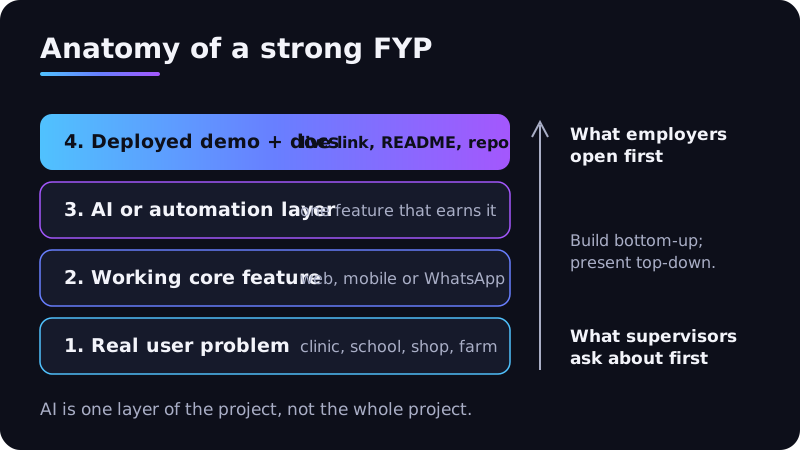
A good final year project solves a real problem for a specific user, uses at least one technology employers are hiring for, and ends in something people can actually open and use.
Three things have changed in the last two years:
- AI is a building block, not the whole project. Calling a language model API is now one feature, like a login page. The project is what you build around it: data, workflow, interface, evaluation.
- Free tiers make real deployment possible. Google's Gemini API has a free tier (Google AI for Developers), Supabase has a free plan for a Postgres database (Supabase pricing), and the GitHub Student Developer Pack bundles credits and tools for verified students (GitHub Education).
- Open models run on a laptop. Tools like Ollama run open-weight models locally, so a project can work without paying for every request, which also helps when the internet is unreliable during a demo.
Your department sets the rules on scope, team size and approval. The HEC's revised computing curriculum, notified in October 2025, puts specific emphasis on final year projects and practical work (Higher Education Commission), so expect supervisors to ask what your project actually does, not just what it is called.
AI agents and LLM apps
These are the ideas closest to what companies are building right now. The work is in retrieval, tools and evaluation, not in the model itself. If agents are new to you, read what AI agents actually do for a small business first.
- 1. Department handbook assistant. Answers students' questions from the prospectus, timetable and course outlines, and cites the page it used. Stack: Python, LlamaIndex or LangChain, pgvector, Gemini API or a local model. Difficulty: medium.
- 2. Roman Urdu support agent with tools. A chat agent that understands Roman Urdu and English, checks an order's status in a database and books a callback, rather than only chatting. Stack: Python or Node, function calling, Postgres. Difficulty: medium to hard.
- 3. Lecture-to-notes generator. Transcribes a recorded lecture (English or mixed Urdu-English), produces structured notes and a ten-question quiz. Stack: Whisper, an LLM for summarising, a simple web front end. Difficulty: medium.
- 4. Pull-request review assistant. Reads a student's GitHub pull request, flags likely bugs and missing tests, and posts comments. Stack: GitHub API, webhooks, LLM. Difficulty: medium.
- 5. Interview practice coach. Asks role-specific interview questions by voice, scores answers against a rubric and tracks progress. Stack: speech-to-text, LLM, React. Difficulty: hard.
- 6. Shop assistant over MCP. Exposes a small shop's inventory and orders through a Model Context Protocol server so an AI assistant can answer "how many of X are left" safely. Stack: TypeScript or Python MCP SDK, SQLite. Difficulty: hard.
Automation, WhatsApp and chatbots
Pakistani businesses run on WhatsApp, so a project here maps directly onto paid work after graduation. Meta's WhatsApp Cloud API documentation covers the developer setup; we explain the business side in the WhatsApp Business API in Pakistan.
- 7. Clinic appointment bot. Patients book, cancel and get reminders on WhatsApp; the clinic sees the day's list on a dashboard. Stack: WhatsApp Cloud API, Node or FastAPI, Postgres. Difficulty: medium.
- 8. School fee and attendance notifier. Sends parents absence alerts and fee reminders, with replies logged for the office. Stack: Laravel or Django, WhatsApp API, cron jobs. Difficulty: easy to medium.
- 9. Receipt-to-spreadsheet extractor. A photo of a handwritten or printed bill becomes a structured row in a Google Sheet. Stack: OCR, LLM for field extraction, Google Sheets API. Difficulty: medium.
- 10. Lead capture pipeline. Website forms, Facebook leads and WhatsApp messages land in one list with follow-up reminders. Stack: n8n or your own Node workers, Postgres. Difficulty: medium.
- 11. Job alert bot. Collects IT job and internship posts from sites that allow it, filters by skill and city, and sends a daily digest. Stack: Playwright, Python, Telegram or WhatsApp. Difficulty: easy to medium.
Web apps and SaaS
Web projects are the easiest to deploy and show to an employer. Make one multi-user and role-based and it stops looking like a semester assignment.
- 12. Multi-school management SaaS. One system, many schools, each with its own admins, teachers and parents. Stack: Next.js or Laravel, Postgres with row-level separation. Difficulty: hard.
- 13. Clinic queue and token display. Reception issues tokens, a TV screen shows the current number, patients get an SMS or WhatsApp when they are next. Stack: WebSockets, React, Node. Difficulty: medium.
- 14. Small-business invoicing app. Quotations, invoices as PDF, payment status and a monthly summary. Stack: Django or Next.js, PDF generation. Difficulty: medium.
- 15. Campus book exchange. Students list used books and notes by course code; buyers message the seller in the app. Stack: any web framework, image upload, search. Difficulty: easy.
- 16. Event registration with QR check-in. Seminar sign-ups, QR tickets and a phone-based scanner for the door. Stack: React, a QR library, Supabase. Difficulty: easy to medium.
- 17. FYP tracker for supervisors. Weekly logs, milestone deadlines, file submissions and supervisor comments per group. Stack: Next.js, Postgres, role-based access. Difficulty: medium.
Mobile apps
Choose mobile when the user is away from a desk: in a field, on a bus, in a shop. Build one codebase with Flutter or React Native unless your department asks for native.
- 18. Offline-first field survey app. Agriculture or health workers collect data without signal; it syncs when they are back online. Stack: Flutter, SQLite, a sync API. Difficulty: medium.
- 19. Blood donor finder. Donors by blood group and area, with an urgent-request broadcast. Stack: Flutter, Firebase or Supabase. Difficulty: easy to medium.
- 20. University transport tracker. Students see where the van or bus is and when it will reach their stop. Stack: driver app with GPS, maps, WebSockets. Difficulty: medium.
- 21. Medicine availability locator. Pharmacies update stock for common medicines; patients search before travelling. Stack: Flutter, REST API, maps. Difficulty: medium.
Data science and machine learning
Data projects need data first. Before you commit, confirm you can get a usable dataset from Kaggle, a public source or a partner who agrees to share it.
- 22. Crop disease detection. A phone camera identifies common diseases in wheat, maize or sugarcane leaves and suggests the next step. Stack: a CNN or Ultralytics YOLO, a mobile front end. Difficulty: medium to hard.
- 23. Vegetable price forecaster. Predicts next week's wholesale prices from past market data and weather. Stack: pandas, Prophet or gradient boosting, a dashboard. Difficulty: medium.
- 24. Early warning for struggling students. Flags students at risk from attendance and quiz patterns, using anonymised data and an ethics note. Stack: scikit-learn, a teacher dashboard. Difficulty: medium.
- 25. Urdu misinformation classifier. Labels Urdu news headlines and social posts as likely reliable or worth checking. Stack: Hugging Face Transformers, a multilingual model. Difficulty: hard.
- 26. Rooftop solar estimator. Estimates panel output and savings from roof size, location and a household's bills. Stack: Python, solar irradiance data, a web calculator. Difficulty: easy to medium.
Projects built around Mardan and KPK
Local projects have one big advantage: you can meet real users in person. That makes the testing chapter of your report much stronger than a survey of your classmates. If you study at a university in Mardan, such as Abdul Wali Khan University Mardan, Women University Mardan or UET Mardan, your users are a short ride away.
- 27. Marble slab defect grading. A camera over the cutting line spots cracks and colour variation and suggests a grade. Stack: OpenCV, a small vision model, a factory-floor tablet. Difficulty: hard.
- 28. Marble export catalogue. Units list their stone with photos and specifications; buyers send enquiries in English. Stack: Next.js or WordPress, image optimisation. Difficulty: easy to medium.
- 29. Pashto text or speech toolkit. Collect a small labelled Pashto dataset and fine-tune a classifier or speech model; publish the dataset. Hugging Face already lists some Pashto-tagged models to start from. Stack: Transformers, Whisper fine-tuning. Difficulty: hard, research-style.
- 30. Urdu document OCR and search. Scanned Urdu notices or records become searchable text. Stack: OCR, post-correction, full-text search. Difficulty: hard.
- 31. Tutor and academy finder. Parents find tutors and academies by subject and area, with an Urdu interface. Stack: Laravel or Next.js, maps. Difficulty: easy.
- 32. Sugarcane delivery scheduler. Growers get time slots at the mill gate instead of queuing for hours. Stack: web dashboard, WhatsApp or SMS alerts, a scheduling algorithm. Difficulty: medium to hard.
Talk to the business before you promise anything in a proposal. A marble unit owner or a clinic manager will tell you in ten minutes which part of the idea they would actually use. Our survey of how Mardan businesses show up online is a useful starting point for local problems.
Ideas by difficulty and team size
Match the idea to your team, not the other way round. A hard project done halfway scores worse than a medium project that works end to end.
| Difficulty | Good for | Example ideas | Extra effort goes into |
|---|---|---|---|
| Easy | 2 members, or a strong solo | 15, 16, 19, 26, 31 | Polish, real users, deployment |
| Medium | 2-3 members | 1, 3, 4, 7, 9, 13, 17, 20, 23 | Integration, testing, a clear demo |
| Hard | 3-4 members | 2, 5, 6, 12, 22, 25, 27 | Evaluation, architecture, data |
| Research-style | 3-4 members with a research-minded supervisor | 29, 30, 32 | Dataset, experiments, a paper-style report |
An "easy" idea is not a weak idea. A blood donor finder with 200 real sign-ups beats a crop disease model that only works on the training set.
Make any idea stronger
- Add one AI feature that earns its place, such as search over your own data or a summary of a long record, not a chatbot bolted onto the corner.
- Deploy it. A URL or an APK on a phone during the viva changes the conversation.
- Measure something: response time, accuracy on a held-out set, or how many real users signed up.
- Write a README a stranger can follow (GitHub Docs).
Choosing between ideas is its own decision; we cover it in how to choose a final year project that helps you get hired.
FYP ideas FAQ
Can I use ChatGPT, Gemini or Claude inside my FYP?
Usually yes, as a component, if your department allows it and you explain what the model does and how you checked its output. Using an AI tool to write your code or report for you is a different matter: follow your department's policy and be ready to explain every line in the viva.
Which idea is best for software engineering students?
Pick one where the process shows: requirements, design, testing and deployment. Ideas 7, 12, 13, 14 and 17 suit an SE-focused report well because they have clear users, roles and workflows to document.
Which ideas suit IT students?
Ideas that integrate existing systems: 8, 9, 10, 11 and 16. IT projects are judged on how well the pieces work together, how they are secured and how they are deployed.
Can I buy a ready-made project?
No. Buying or outsourcing an FYP is academic misconduct, it usually falls apart in the viva, and it leaves you with nothing to show an employer. Get help understanding things; build the project yourself.
Key takeaways
- Pick a real problem for a specific user first; the technology comes second.
- Treat AI as one feature inside a complete product, with data, workflow and evaluation around it.
- Free tiers, student packs and local open models make a deployed, working project realistic for any final-year group.
- Match difficulty to team size; a medium project that works beats a hard one that does not.
- Local problems in Mardan and KPK give you real users to test with, which strengthens your report.
- Follow your department's rules on scope and approval, and never buy or outsource the project.
Get mentorship for your FYP
Softhat mentors final-year students at our Mardan, Khyber Pakhtunkhwa office or remotely: choosing and scoping the idea, the proposal, architecture, weekly code reviews, AI integration, deployment, documentation structure and viva practice. You build the project; we help you build it properly. See FYP mentorship, or learn the stack first in our AI automation course and Python course.