- Careers & Skills
Scope of Computer Science in Pakistan: Careers After BS CS
The real scope of computer science in Pakistan in 2026: career paths after BS CS, skills for each, local vs remote work, KPK and Mardan realities, and a first-year plan.
 AuthorRehmat Ullah8 min read
Table of Contents
"What is the scope of computer science in Pakistan?" is a question every BS CS student hears from relatives, and many ask themselves in their final year. Some classmates already have offers; others have sent a hundred applications and heard nothing.
Both are true at once. The industry is growing, but it does not hire degrees: it hires people who can show what they can do. The scope of a CS degree in Pakistan depends much more on what you build during and after it than on the degree title.
This guide covers what the numbers say about the industry, the main career paths after BS CS and the skills each one needs, local versus remote work, an honest look at Khyber Pakhtunkhwa and Mardan, and a plan for your first year after graduation.
Is there scope for computer science in Pakistan?
Yes. Pakistan's IT sector is one of the few parts of the economy that has kept growing and earning foreign exchange, which is why the government treats it as a priority.
- Exports are rising. ICT export remittances reached US $3.38 billion in July-March FY2026, up 19.7 percent on the same period a year earlier, the highest of any service sector (Pakistan Economic Survey 2025-26).
- There are many employers. 34,420 IT and IT-enabled services companies were registered with the SECP as of March 2026 (Pakistan Economic Survey 2025-26). Most are small, which matters for how you job-hunt.
- Freelancing is significant. Tech freelancer exports reached US $856.3 million in the same nine months, up 51 percent (same source).
The competition is real too. The same survey describes a government system being built to manage more than 75,000 IT graduates a year (same source). A degree puts you in that pool; skills and proof of work get you out of it.
Career paths after BS CS
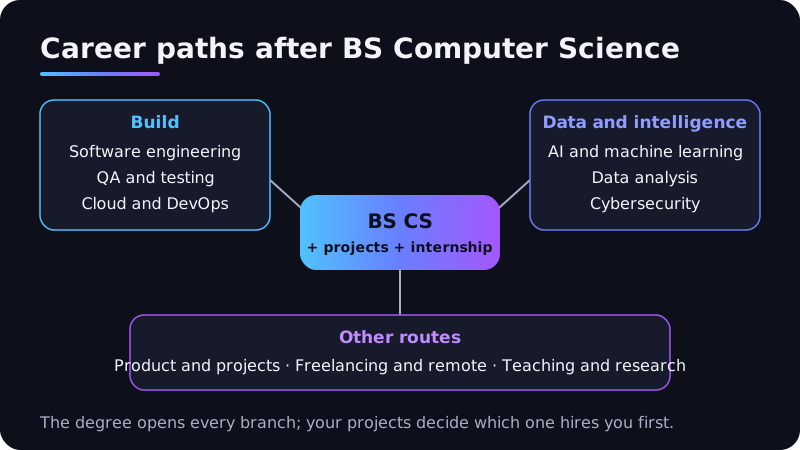
Most CS graduates in Pakistan end up in one of nine paths. You do not have to choose on graduation day, but choosing within the first year speeds everything up.
Software engineering
Building web, mobile and backend systems. This is still the largest employer of CS graduates. Skills: one language properly (JavaScript/TypeScript, Python, Java or C#), a framework, databases and SQL, Git, APIs and testing.
AI and machine learning
Two very different jobs share this name. Applied AI engineering, building products that use AI models through APIs, agents and automation, is where most of the openings are in 2026. ML research and model training needs strong maths and usually a postgraduate degree. Skills: Python, APIs, prompt design, data handling, evaluation; for ML, statistics and linear algebra. The government lists its Artificial Intelligence Policy 2025 among its key IT initiatives (Pakistan Economic Survey 2025-26), so AI work is likely to grow beyond private companies too.
Data analysis and data engineering
Turning business data into reports and decisions, or building the pipelines that move it. Skills: SQL above all, Excel, Python (pandas), a BI tool such as Power BI, and the ability to explain numbers to non-technical people.
Cloud and DevOps
Deploying and running software reliably. Skills: Linux, networking basics, Docker, a cloud provider, CI/CD and scripting. Often a second step after a year or two as a developer.
Cybersecurity
Protecting systems and data. Entry roles are in security operations and testing. Skills: networking, Linux, web vulnerabilities, and recognised certifications later. Banks, telecoms and government bodies are the main local employers.
QA and software testing
Finding problems before users do, increasingly with automated tests. A good entry point for graduates who are careful and systematic, and a path many people later move from into development or product.
Product, project and business roles
Product managers, project managers and business analysts sit between clients and developers. A CS background is a real advantage, but you need communication and organisation skills that the degree does not teach.
Freelancing and remote work
Working for clients abroad, either through platforms or directly. It suits people who are disciplined and good at writing. Our guide to freelancing skills for students covers which skills clients pay for.
Teaching and research
University teaching generally expects at least an MS, and research roles a PhD. If you enjoy your FYP's research side more than shipping software, this path is worth considering early, because it shapes which MS programmes and supervisors you aim for.
Skills by path at a glance
| Path | Core skills to build first | Good first proof of work |
|---|---|---|
| Software engineering | One language, a framework, SQL, Git | A deployed app with real users, even few |
| Applied AI / automation | Python, AI APIs, workflows, evaluation | A working assistant or automation for a real task |
| Data | SQL, Excel, Python, a BI tool | A dashboard built on public data |
| Cloud / DevOps | Linux, Docker, CI/CD, one cloud | Your own project deployed with a pipeline |
| Cybersecurity | Networking, Linux, web security | Write-ups of legal practice labs |
| QA | Test design, automation tools | A test suite for an open-source project |
Local jobs vs remote work
Most CS graduates in Pakistan work for a local company, a Pakistani company serving foreign clients, or a foreign client directly. Each has trade-offs.
- Local companies offer training, structure and teammates. Pay varies widely by city and company.
- Pakistani companies with foreign clients are where much of the export growth comes from. They expect good English and remote collaboration skills.
- Direct remote work gives the widest choice but the least support. It is easier after a year or two of team experience.
A common, sensible route: a local job or internship for the first year, then remote or export-focused work once you can work independently.
Where the jobs are: KPK and Mardan, honestly
Most large IT employers are in Islamabad and Rawalpindi, Lahore and Karachi. Peshawar has a growing scene. Smaller cities like Mardan have fewer and smaller employers, so you need to be more creative.
What Mardan has
Mardan has a substantial pool of computing students across Abdul Wali Khan University Mardan, the University of Engineering & Technology, Mardan and Women University Mardan, plus colleges. It has software houses, including ours, and a large base of local businesses that are only starting to go digital: our survey of Mardan businesses online found many with no website.
What that means for you
- Local jobs exist, but you will compete for fewer openings. A strong portfolio matters even more.
- Remote work and export-focused companies close much of the gap, as long as your internet and power backup are reliable.
- Local businesses are a real market for automation, websites and software. Our article on AI automation for Mardan businesses shows the kind of work they need.
- Moving to a bigger city for one or two years early in your career is a reasonable choice, not a failure.
Softhat hires and trains developers at its office in Mardan, Khyber Pakhtunkhwa; current openings, such as Python & AI Developer, Web Developer and AI Automation Engineer, are listed on our jobs page.
Your first year after graduation: a roadmap
The first twelve months after BS CS set the direction for the next five. Here is a practical plan.
- Months 1-2: choose a path and close gaps. Pick one path from the list above. Rebuild your FYP into a clean, documented portfolio piece and fix your CV and GitHub.
- Months 2-4: get inside a team. Take an internship or junior role, even a modest one. Team experience is what most fresh graduates lack. Our guide on how to get an IT internship in Pakistan covers how.
- Months 4-8: go deep on one stack. Build two projects that match the jobs you want, using the tools those companies use.
- Months 6-12: show your work publicly. Write about what you built on LinkedIn, contribute to an open-source project, or take a small freelance job.
- Month 12: review. Are you being shortlisted? If not, the problem is usually proof of work or the path you chose, not the degree.
Still at university? The project you choose in your final year shapes all of this. See how to choose a final year project, and if you want guidance from working developers, our FYP mentorship page explains how it works.
Scope of CS FAQ
Is computer science still worth it with AI writing code?
Yes, but the job is changing. AI tools write routine code faster; people who understand systems, data, security and the client's problem are needed to direct and check that work. Learn to use AI tools well, and focus on what they cannot do.
BS CS, BS IT or BS Software Engineering: which has more scope?
Employers in Pakistan hire from all three for most developer roles. Your skills and projects matter more than which of the three is on your degree.
Can I get a job without a high CGPA?
Many private companies care more about projects and interviews than CGPA. Some large employers, government jobs and scholarships do filter by it.
Key takeaways
- Pakistan's IT sector is growing, with record ICT exports and over 34,000 registered IT companies, but it hires skills, not degrees.
- The main paths after BS CS are software engineering, applied AI, data, cloud/DevOps, cybersecurity, QA, product roles, freelancing and teaching.
- Applied AI and automation are where much of the new demand sits in 2026.
- In Mardan and smaller KPK cities, combine local work, remote work and a strong portfolio; a move to a bigger city is a valid option.
- Use the first year after graduation to pick a path, join a team, go deep on one stack and show your work.
Start your career with real projects
If you are a student or fresh graduate, see the internships and jobs open at Softhat, and apply with your CV and your best project. Questions about which path suits you? Get in touch.