- AI & Automation
AI Agents for Small Businesses: What They Are and Where They Actually Help
A plain-English guide to AI agents for small businesses: how they differ from chatbots, where they help, the risks, and how to start small.
 AuthorRehmat Ullah8 min read
Table of Contents
"AI agents" is now on every software vendor's homepage. For a small business owner, the real question is simpler: will it save my team time or win me more customers, and what can go wrong?
This guide explains AI agents for small businesses in plain terms. You will learn what an agent is, how it differs from a chatbot, where it genuinely helps a Pakistani SME, and how to start without a large budget or a large risk.
What is an AI agent, in plain English?
An AI agent is software that uses a large language model (LLM, the technology behind tools like ChatGPT) to decide which steps to take and which tools to use to finish a task.
A normal chatbot answers a question. An agent can also act: look up an order, check a calendar, update a spreadsheet or draft a quotation.
Anthropic, the company behind Claude, draws a useful line in its guide Building effective agents:
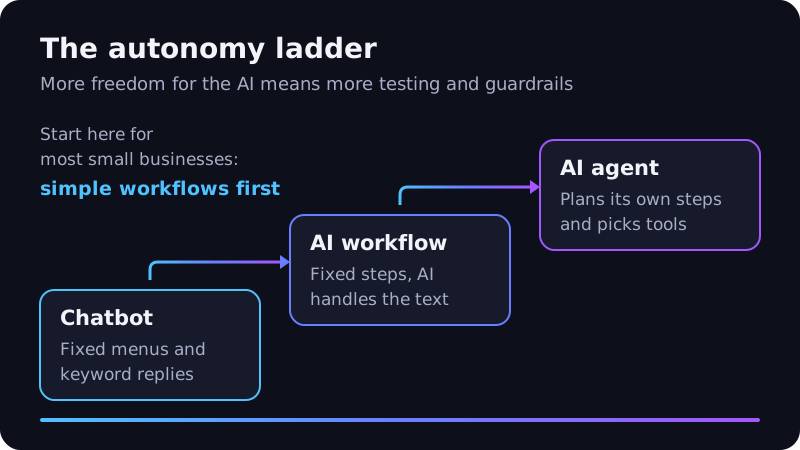
- Workflows follow predefined steps. The AI fills in parts, but you decide the path.
- Agents decide their own path and choose which tools to use as they go.
The same guide recommends finding the simplest solution possible and only adding complexity when needed. That advice matters for small businesses, because most of the value comes from simple workflows, not fully autonomous agents.
Chatbot vs automation vs AI agent
These three terms get mixed up. The difference is how much the software decides on its own.
| Rule-based chatbot | Automated workflow with AI | AI agent | |
|---|---|---|---|
| How it works | Fixed menus and keyword replies | Fixed steps, AI handles text inside them | AI plans steps and picks tools |
| Example | "Press 1 for prices" | New lead is summarised by AI and added to the CRM | Customer asks to reschedule; agent checks slots, moves booking, confirms |
| Predictability | Very high | High | Lower |
| Setup effort | Low | Medium | Higher |
| Best for | Simple FAQs | Repeatable back-office tasks | Varied requests that need several tools |
Are businesses actually using AI agents?
Interest is high, but full rollouts are still limited. McKinsey's State of AI survey (November 2025) found that 23% of respondents said their organizations were scaling an agentic AI system somewhere in the enterprise, and another 39% were experimenting with agents.
The same survey found that in any single business function, no more than 10% of respondents reported scaling agents. In other words, most companies are still testing.
In Pakistan, the federal cabinet approved the National AI Policy 2025 in July 2025, which aims to build skills and an AI ecosystem. For a small business, the practical takeaway is that AI tools and talent are becoming easier to find locally, not that you need an agent tomorrow.
Where AI agents help small businesses
The best use cases share three traits: the task is frequent, it follows a recognisable pattern, and a mistake is easy to catch or undo.
1. Customer enquiries on WhatsApp and your website
Many Pakistani businesses get the same questions every day: price, availability, delivery time, location. An AI assistant connected to your product list can answer instantly, including late at night.
A step further, it can check live stock or order status and hand complex chats to a human. Our WhatsApp Business API guide explains the platform side, including Meta's rules on business AI bots.
2. Lead qualification
An agent can ask a new lead a few questions (budget, city, timeline), score the answers and pass warm leads to sales with a summary. Your team spends time on people who are ready to buy. See our guide to lead generation for how this fits your funnel.
3. Appointment booking and reminders
Clinics, salons, consultants and training institutes lose time to back-and-forth scheduling. An agent that reads your calendar can offer free slots, book, reschedule and send reminders.
4. Back-office admin
Good candidates include:
- Reading supplier invoices and entering key fields into a sheet.
- Summarising daily sales or support tickets into a short report.
- Drafting replies to routine emails for a human to approve.
- Sorting incoming messages by urgency or department.
5. Reviews and reputation monitoring
An agent can collect new Google reviews, flag negative ones and draft polite responses for approval. This supports the habits in our guide on managing your online reputation.
Where AI agents are not a good fit (yet)
Agents are not the right tool for every job. Be careful with:
- Money movement. Refunds, payments and discounts should need human approval.
- Legal, medical or financial advice. An AI can draft, but a qualified person must decide.
- Rare, high-stakes decisions. If a task happens twice a year, automation rarely pays back.
- Messy data. If your price list lives in five different WhatsApp groups, fix that first.
The risks, and how to manage them
AI agents fail differently from normal software. They can sound confident while being wrong.
Wrong or invented answers
LLMs can produce plausible but false information. Limit the agent to your approved content (product list, policies, FAQs) and tell it to hand over to a human when unsure.
Prompt injection and too much power
The OWASP Top 10 for LLM Applications 2025 lists prompt injection as the top risk. This is when someone writes text that tricks the AI into ignoring its instructions. The same list includes "excessive agency", where an AI is given more tools, permissions or autonomy than it needs.
Practical guardrails:
- Give the agent read-only access wherever possible.
- Require human approval for anything that spends money, deletes data or messages many people.
- Log every action so you can review what happened.
- Test with tricky messages before going live, including rude, confusing and manipulative ones.
Customer data and privacy
Only send the data the agent needs. Check where your AI provider stores data and whether it is used for model training. Tell customers when they are talking to an automated assistant.
How to start with AI agents: a 5-step plan
- Pick one painful, repeatable task. For example, answering "price and delivery" questions on WhatsApp.
- Measure today's baseline. How many messages a day? How long is the average first reply? How many leads go cold?
- Start as a workflow, not a free agent. Fixed steps with AI inside them are easier to test and cheaper to run.
- Keep a human in the loop. Let the AI draft or answer simple cases, and route everything else to staff.
- Review weekly for a month. Read real conversations, fix wrong answers, then expand to the next task.
Cost drivers to plan for
Costs vary widely, so ask for a breakdown covering:
- AI model usage: usually billed per amount of text processed.
- Channel fees: for example, Meta's per-message charges on WhatsApp.
- Integration work: connecting your CRM, store, sheets or booking system.
- Hosting and automation tools: such as a workflow platform.
- Ongoing tuning: someone must review conversations and update content.
Questions to ask before you buy
Whether you hire an agency or buy a ready-made tool, ask these questions first:
- Which systems will it connect to, and does it only read data or can it change it?
- What happens when it does not know the answer? Look for a clear handover to a named person or team.
- Can it handle Urdu and Roman Urdu? Many Pakistani customers type "price kya hai?" rather than formal English, so test with real messages from your inbox.
- Where is conversation data stored, who can see it, and is it used to train AI models?
- How will we measure success? Agree on two or three numbers, such as first reply time, leads qualified per week or hours of admin saved.
- Who updates it when prices, stock or policies change?
A vendor who answers these clearly is more likely to deliver something your team will actually use.
A simple example
Consider a furniture shop in Lahore or Mardan that gets dozens of WhatsApp enquiries a day after posting on Facebook. A sensible first project:
- The assistant replies instantly with prices and photos from an approved catalogue.
- It asks for the customer's city to confirm delivery options.
- It collects name, product and budget, then posts a short summary to the sales team.
- Anything unusual, such as custom sizes or complaints, goes straight to a person.
Nothing here spends money or makes promises the shop cannot keep. Once it runs smoothly, the shop can add order tracking or payment reminders.
Key takeaways
- An AI agent can decide steps and use tools. A chatbot mostly answers.
- Most small businesses get faster, safer results from simple AI workflows first.
- Strong use cases: customer enquiries, lead qualification, bookings, admin and review monitoring.
- Keep humans in charge of money, advice and rare high-stakes decisions.
- Limit permissions, log actions and test before launch.
Build an AI assistant that fits your business
AI agents for small businesses work best when they do one job well, connect to your real data and hand off to people at the right moment. Start small, measure and grow from there.
Softhat designs AI automation and custom AI agents for Pakistani businesses: assistants that answer customers, qualify leads and handle routine admin, with guardrails built in. Book a free strategy call and we will help you pick the first task worth automating.