

- AI & Automation
- Web Development
Small Industrial Estate Mardan: Moving Marble Factories from Registers to Software
A practical guide for factory owners in Small Industrial Estate Mardan: what to put on software first, a 30-day plan, and what to ask before you pay anyone.
 AuthorRehmat Ullah7 min read
Table of Contents
Walk through Small Industrial Estate Mardan on a working day and you will hear gang saws before you see anything else. Blocks arrive from the quarries, slabs are stacked by variety and size, trucks leave for dealers across the province, and in a small office a munshi writes all of it into registers.
That system has worked for years. It starts to strain when the owner asks a simple question and nobody can answer it without an afternoon of adding up pages: how many slabs did that block give, what is lying in the yard, and which dealer still owes us money?
This guide is for owners and managers in the estate who want those answers on their phone. It covers what to put on software first, what to leave for later, a realistic 30-day plan and the questions to ask before paying anyone, including us.
Small Industrial Estate Mardan at a glance
The estate is one of the industrial estates run by the Khyber Pakhtunkhwa Small Industries Development Board (SIDB), which also runs small industrial estates in Peshawar, Charsadda, Kohat, Abbottabad, Mansehra and other districts (Business Recorder).
| Run by | Small Industries Development Board, Khyber Pakhtunkhwa |
| Phases | 3 |
| Area | About 473 acres |
| Units | About 200, mostly marble and granite |
| Expansion | A fourth industrial estate in Mardan has been proposed |
Figures as reported by Business Recorder in March 2022; the number of working units changes over time.
In other words, the estate is largely a marble and granite cluster. Marble processing is one of Khyber Pakhtunkhwa's characteristic industries, with deposits in areas such as Buner, Mohmand, Swat, Chitral and Mardan itself.
How most units run today
Most marble units keep the same set of records, whatever their size:
- A block register: which quarry, which variety, which truck, what weight or size, what rate.
- A cutting register, if one exists at all: which block went on which saw, and roughly how many slabs came off it.
- Stock in the yard, usually in the supervisor's head or on a sheet that is out of date by the afternoon.
- A dealer khata: who took what, on what credit, and what they have paid back.
- Gate passes and challans for each truck that leaves.
- Labour attendance and wages, often piece-rate, in another register.
- WhatsApp groups where photos of slabs, payment screenshots and orders all mix together.
None of this is wrong. It is simply slow to add up, easy to lose and impossible to see from anywhere except the office.
Five questions most owners cannot answer quickly
- What did this block actually give? Yield and wastage per block is how you know whether a quarry, a variety or a saw operator is costing you money.
- What is in the yard right now, by variety, size and finish? Dealers ask this on WhatsApp every day.
- Which dealers owe what, and since when? Credit is where most of the money in the trade sits.
- What did one square foot really cost? Blocks, electricity, diesel, blades, polish and labour all have to be in the number.
- What left the gate today? And was every truck billed?
If any of these takes more than a minute to answer, that is where software pays for itself first.
What to put on software first
Do not try to computerise the whole factory at once. Start with the records that hold money, then the ones that hold stock.
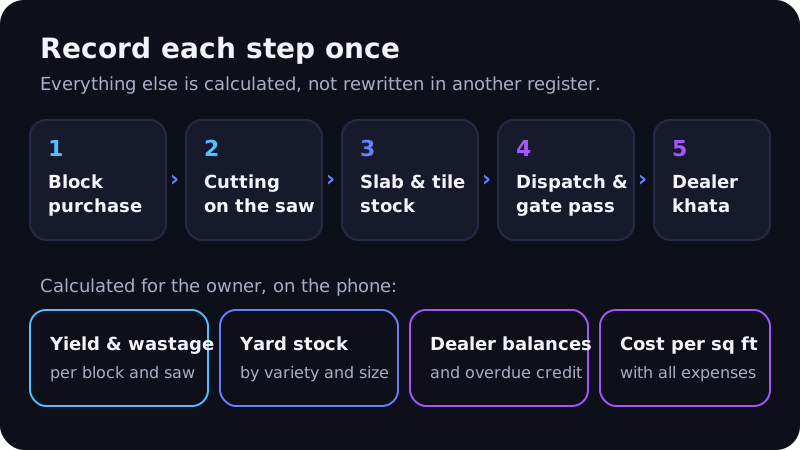
| Order | Record | Why it comes here |
|---|---|---|
| 1 | Dealer khata and payments | This is where the money is. Balances, ageing and reminders stop credit from drifting |
| 2 | Dispatch, gate passes and challans | Every truck billed, every dispatch linked to a dealer and an order |
| 3 | Slab and tile stock | Answer "what do you have in 18 mm polished?" from the phone, with photos |
| 4 | Block register and cutting | Yield and wastage per block, per quarry and per saw |
| 5 | Labour, attendance and wages | Piece-rate and daily wages calculated, not argued over |
| 6 | Running costs | Electricity, diesel, blades and maintenance, so cost per square foot is real |
Steps 1 and 2 alone usually change how the office works. Steps 3 and 4 are where owners start seeing things they never saw before, such as which variety wastes the most or which saw gives the lowest yield.
A realistic 30-day plan
| Week | What happens | What the owner sees |
|---|---|---|
| 1 | We visit the factory, photograph the registers and agree what goes in first | A short written plan and quotation |
| 2 | Dealer khata and opening balances entered; the munshi is trained on the phone and office computer | Every dealer's balance in one list |
| 3 | Dispatch and gate passes go live; slab and tile stock counted once and entered | What left today, and what is in the yard |
| 4 | Block register and cutting records start; first weekly report on WhatsApp | Yield per block and the week's sales and dues |
The registers do not disappear on day one. For the first two weeks most factories keep both, check the software against the paper, and then stop writing the paper once the numbers agree.
Weak internet, load-shedding and Urdu
These are the real constraints in the estate, and the system has to be built around them rather than around a showroom demo.
- Load-shedding and weak signal. Entries should keep working on the office computer and phones when the connection drops, and sync when it returns.
- Urdu screens. The munshi and yard supervisor should see labels in Urdu if that is what they read. Training on the yard can be in Pashto.
- Phones, not only computers. Most entries happen in the yard, not at a desk.
- Rates stay private. Purchase rates and profit should be visible only to the owner and whoever he chooses, never to every user.
- Backups. Daily backups, and the owner keeps a copy of his own data.
What to ask any software vendor
Whether you work with us or anyone else, ask these before you pay:
- Have you seen how a marble factory works? Ask them to explain block yield back to you. If they cannot, the software will not track it.
- Who owns the data, and can I export it? The answer must be you, and yes.
- Does it work offline and in Urdu? Ask for a demonstration, not a promise.
- Who trains the munshi, and for how long? Software that only the owner's son can use will stop being used.
- What happens after launch? Support, updates, backups and what they cost.
- Can we start with one module? A vendor who insists on everything at once is selling, not solving.
For the wider version of this checklist, see which parts of your business AI and software should run.
Not a marble unit?
If your unit makes something other than marble, the same approach applies: money records first, then stock, then production and costs. That is covered on our ERP and factory management page. Shops and wholesalers supplying the estate usually need POS and stock software instead.
Frequently asked questions
Is this ready-made software?
It is built for your factory, starting from a base designed for marble and granite units and shaped around your own registers, varieties and sizes. You do not change how you work to fit the software.
How much does it cost?
It depends on how many modules you start with and how many users need access. We visit, see your registers and give a written quotation. There is no charge for the visit or the quotation.
Can the old registers be entered?
Opening balances for dealers and current stock are entered at the start. Older history can be added later if you want it; most owners only need the balances.
What if the munshi leaves?
That is a strong reason to move off paper. The records stay in the system under your ownership, and a new munshi is trained on the same screens.
Key takeaways
- Small Industrial Estate Mardan is run by SIDB Khyber Pakhtunkhwa and is largely a marble and granite cluster of around two hundred units.
- Most units run on block, cutting and khata registers plus WhatsApp groups, which are slow to add up and invisible outside the office.
- Put dealer khata and dispatch on software first, then slab stock, then block yield, wages and running costs.
- A realistic rollout takes about a month, with paper and software running side by side until the numbers agree.
- Insist on Urdu screens, offline working, private purchase rates, training for the munshi and full ownership of your data.
See your factory's numbers on your phone
Our office is in Mardan, Khyber Pakhtunkhwa, so we can visit factories in the estate. Tell us how your unit works today and we will show you what the first month on software would look like. See the marble factory management system or call +92 315 9300600.