
- E-commerce
- Web Development
Accepting Online Payments in Pakistan: Options for E-commerce Websites
Compare ways of accepting online payments in Pakistan: Raast, JazzCash, Easypaisa, PayFast, bank gateways and COD, plus costs and documents to prepare.
 AuthorRehmat Ullah8 min read
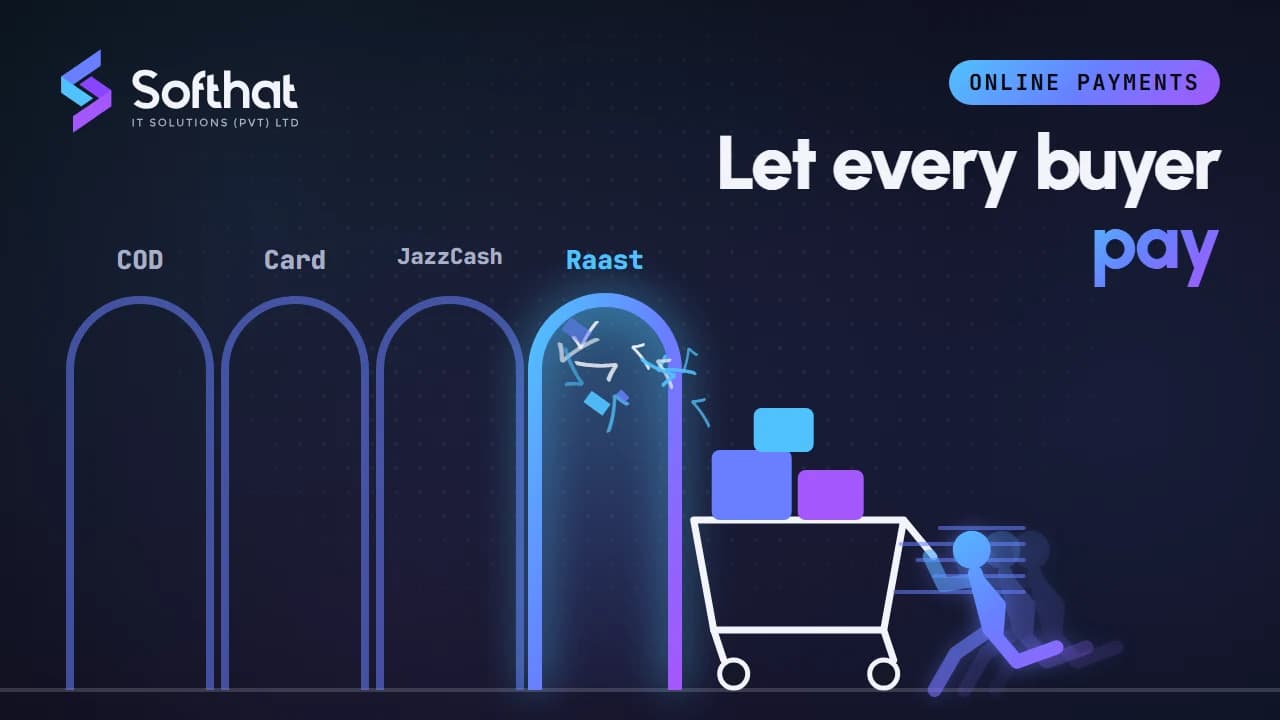
Table of Contents
Your online store can have great products and fast delivery, yet still lose sales at the last step. If the checkout does not offer a payment method the customer trusts, many will simply leave.
Accepting online payments in Pakistan is easier than it was a few years ago. Raast, mobile wallets, licensed gateways and bank solutions all compete for your checkout. This guide explains each option, what drives the cost and which documents to prepare before you apply.
Why your payment options matter
Pakistani shoppers pay in many different ways. Some use a JazzCash or Easypaisa wallet daily. Others prefer a bank app, a debit card or cash at the door.
Each missing option is a group of customers you make work harder. On the other hand, adding every option at once raises your setup work and monthly reconciliation effort.
The goal is a sensible mix: one or two digital methods that cover most of your buyers, plus a clear policy for cash on delivery (COD).
The main ways of accepting online payments in Pakistan
Here is a quick overview before we look at each option in detail.
| Option | What customers use | Typical fit |
|---|---|---|
| Raast P2M | Any participating bank or wallet app | Low-cost instant transfers, QR on delivery |
| Mobile wallet gateways | JazzCash or Easypaisa account | Wallet-heavy audiences, smaller stores |
| Payment aggregators (e.g. PayFast) | Cards, wallets and bank accounts | One integration for many methods |
| Bank payment gateways | Debit and credit cards (e.g. Visa, Mastercard, PayPak) | Established businesses with card buyers |
| Cash on delivery | Cash to the courier | First-time buyers, low digital trust |
Raast P2M (person to merchant)
Raast is the State Bank of Pakistan's instant payment system. In December 2023, SBP launched Raast P2M, which lets customers pay merchants using static or dynamic QR codes, a Raast alias, an IBAN or Request to Pay (Dawn).
Two details matter for store owners. SBP instructed providers not to charge customers for these payments, and merchant fees are left to providers, who were "encouraged to initially waive off such charges" (Business Recorder).
Funds are meant to reach merchant accounts in real time or as agreed with the merchant. SBP later told banks and other regulated entities to enable Raast P2M for account holders selling in store or online by 31 March 2025 (ProPakistani).
For e-commerce, Raast works in two ways. You can add it at checkout through your bank or gateway, or print a QR code on the parcel so the customer pays on delivery (Dawn).
JazzCash and Easypaisa gateways
Both wallets offer merchant gateways for websites and apps.
Easypaisa's Online Payment Gateway supports payment from Easypaisa mobile accounts and over-the-counter tokens paid at Easypaisa shops. It lists plugins for WordPress/WooCommerce, OpenCart, Magento and PrestaShop. Easypaisa states there are no annual or installation charges, with fees charged per transaction. Mobile account payments settle daily and instantly, while OTC tokens take 7 working days (Easypaisa).
JazzCash's Payment Gateway lets customers pay with their JazzCash mobile account at checkout, and JazzCash also offers vouchers, Raast QR and Tap on Phone for in-person card payments. It notes that merchant discount rates (MDR) "may apply as per agreement" (JazzCash).
Payment aggregators such as PayFast
An aggregator combines several payment methods behind one integration. PayFast was the first payment gateway in Pakistan to receive a commercial licence from SBP, in 2021 (PhoneWorld).
PayFast describes its checkout as letting merchants receive payments through bank accounts, wallets and domestic and international card schemes (PayFast). The main benefit is fewer separate contracts and one dashboard for reconciliation. Several other licensed providers operate in this space too, so compare more than one.
Bank payment gateways and card schemes
Most large banks offer an internet payment gateway (IPG) that lets you accept debit and credit cards on your website. Card acceptance usually covers international schemes such as Visa and Mastercard.
Pakistan also has its own domestic card scheme, PayPak, owned and operated by 1LINK under the aegis of the State Bank of Pakistan (PayPak). Ask your bank which schemes its gateway accepts.
If your website handles card data, security rules apply. The PCI Data Security Standard (PCI DSS) sets requirements for anyone that stores, processes or transmits cardholder data (PCI Security Standards Council). Using a hosted checkout page from your gateway usually reduces how much of that burden sits with you.
Cash on delivery
COD remains common in Pakistan because it removes risk for first-time buyers. It also shifts risk to you: refused parcels, return shipping and waiting for couriers to remit cash.
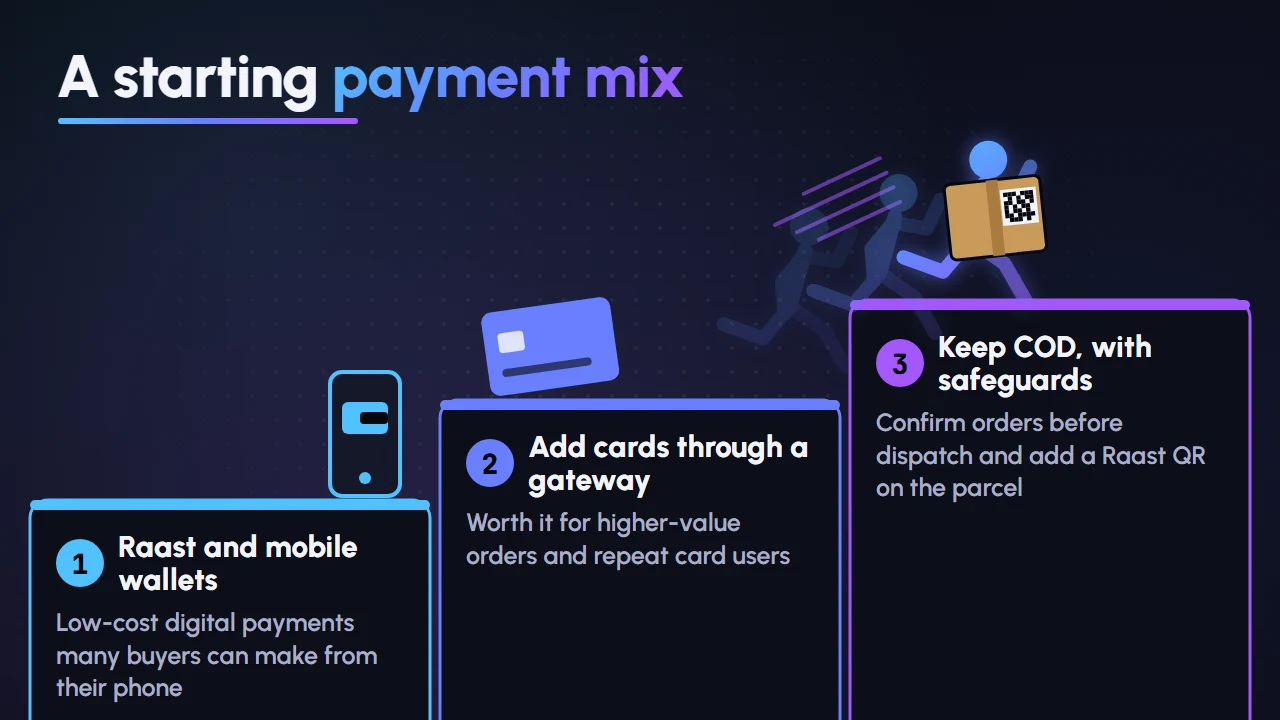
A practical approach is to keep COD but make digital payment attractive. Confirm COD orders before dispatch, for example with automated WhatsApp messages, and offer a Raast QR on the parcel so customers can pay digitally at the door.
What about Stripe and PayPal?
Many store owners ask for these first, especially if they sell abroad.
- Stripe: Pakistan does not appear on Stripe's list of supported countries (Stripe). A Pakistani business cannot open a standard Stripe account directly.
- PayPal: PayPal's worldwide country list does not include Pakistan (PayPal).
Be cautious with workarounds that involve opening accounts in another person's name or using foreign details you do not legitimately hold. They can break provider terms and leave your funds frozen. If you sell internationally, use a registered foreign entity where appropriate, and get professional tax and legal advice.
What drives the cost of a payment gateway
We are not listing fixed prices here, because rates depend on your agreement, sales volume and business type. These are the factors that decide what you actually pay.
- Merchant discount rate (MDR): a percentage or fee on each transaction. Card payments, wallets and Raast are often priced differently.
- Setup, annual or monthly fees: some providers charge none, as Easypaisa states for its gateway, while others do.
- Settlement time: instant, daily or several working days. Slower settlement ties up your cash.
- Refunds and chargebacks: fees and the admin time to handle disputes.
- Taxes: check whether quoted charges include tax.
- Integration effort: a ready plugin is cheaper than a custom API build for a bespoke site.
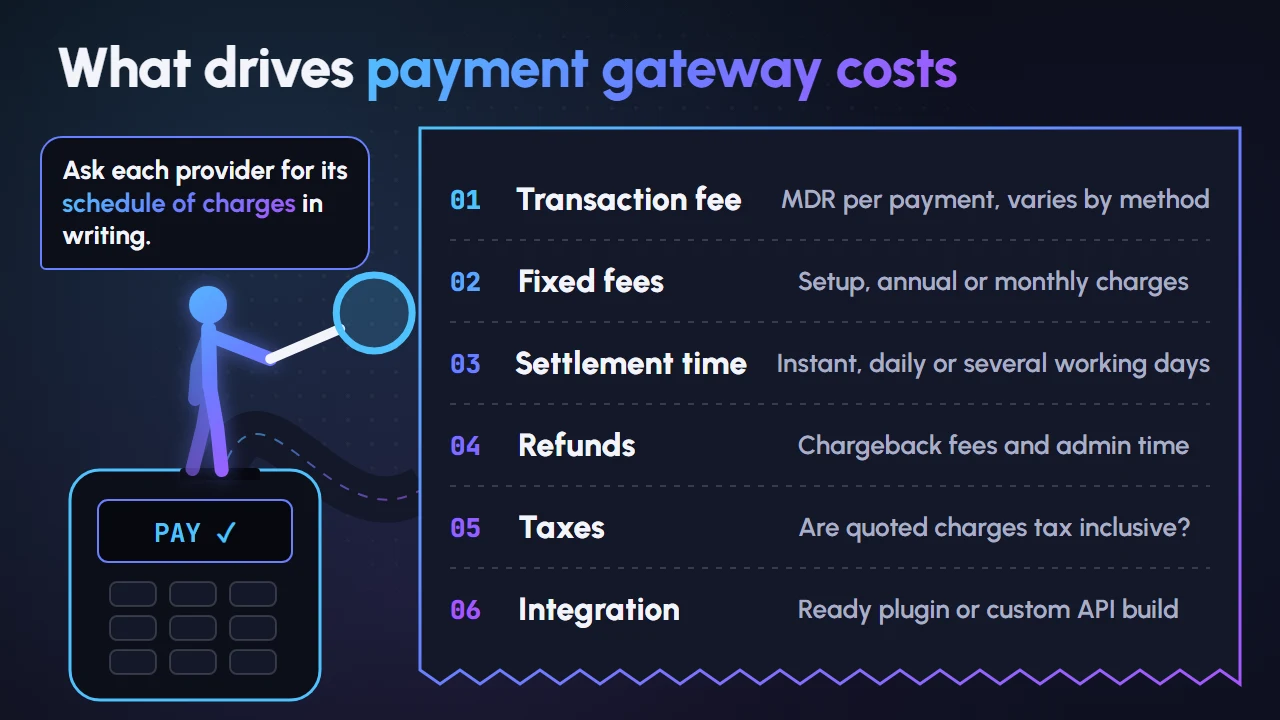
Ask each provider for its current schedule of charges in writing, and calculate the cost on your real monthly order mix.
Documents and website requirements
Providers must verify who you are before you can accept payments. Easypaisa, for example, describes a process of online application with documents, then KYC (know your customer) verification and due diligence, then integration (Easypaisa).
A payment provider's compliance guide lists what merchant onboarding typically requires (Simpaisa):
- Company registration with SECP, or registration with the relevant registrar for firms.
- CNICs of directors and beneficial owners.
- National Tax Number (NTN).
- Proof of business address.
- Bank account verification.
- In many cases, a site visit or video verification.
Requirements vary by provider and business structure, so confirm the exact list before you apply. Sole proprietors often face a different checklist from private limited companies.
Get your website ready too
Reviewers usually check the website itself. Before applying, make sure you have:
- An SSL certificate so every page loads over HTTPS. See our guide on what SSL is.
- Clear refund, return, shipping and privacy policies.
- Visible contact details and a real business address.
- Accurate product descriptions and prices in PKR.
- A working checkout on a test or staging environment.
How to choose the right mix
Use these steps to decide what to set up first.
- Look at your buyers. If most orders come from social media and first-time customers, wallets, Raast and COD matter most. If you sell higher-value items to repeat buyers, add cards.
- Check your platform. Shopify, WooCommerce and custom sites each support different plugins. Confirm a maintained integration exists before signing.
- Compare total cost. Use the cost drivers above with your real order volume.
- Test the checkout on mobile. Most shoppers will pay on a phone, so a slow or confusing payment page hurts conversions. Our guide on page speed explains why every second counts.
- Plan reconciliation. Decide who matches payments, refunds and courier remittances to orders each week.
FAQ
Can I accept payments without a registered company?
Some providers onboard sole proprietors, but the documents differ from those for a company. Ask each provider for its checklist for your business type before applying.
Is Raast free for my customers?
SBP's Raast P2M framework instructs providers not to charge customers for these payments. Merchant fees are set by your provider (Business Recorder).
Should I stop offering cash on delivery?
Usually not straight away. Keep COD for buyers who need it, confirm orders before dispatch and encourage digital payment with a Raast QR or wallet option.
Can I use Stripe in Pakistan?
Pakistan is not currently listed among Stripe's supported countries (Stripe). Use a licensed local gateway for Pakistani customers.
Build a checkout your customers trust
The right payment setup is part technology, part paperwork and part customer psychology. Getting it right means fewer abandoned carts and cleaner books.
Our web development team builds e-commerce websites with local payment gateways, mobile-friendly checkouts and order automation. Start a project and we will help you choose and integrate the right mix for your store.