- Careers & Skills
- Final Year Projects
AI & Machine Learning Project Ideas for Final Year (2026): With Python
27 AI, machine learning and data science project ideas for final year students in Python: LLM and RAG apps, computer vision, Urdu and Pashto NLP, and dashboards.
 AuthorRehmat Ullah12 min read
Table of Contents
Half the groups in a final-year batch now want "an AI project". Most of them end up with the same thing: a chatbot that wraps an API, or a model that scored 99% on its training data and falls apart on the first real photo in the viva.
The difference between those projects and a strong one is not the model. It is the data you chose, the baseline you beat, and how honestly you measured the result.
This list gives 27 AI, machine learning and data science project ideas you can build in Python, grouped by type. Each one names a real dataset, model or library you can use for free, with an honest difficulty rating. If you want the wider list that also covers web, mobile and WhatsApp projects, start with our 32 FYP ideas for computer science; this post goes deeper on AI only and does not repeat those ideas.
What makes an AI project worth a final year
A good AI final year project has a clear task, data you are allowed to use, a simple baseline, and a measured result on data the model has never seen.
Supervisors and interviewers ask the same three questions about any AI project: where did the data come from, what did you compare against, and how do you know it works? Plan your answers before you write any code.
- The task is narrow. "Detect helmets on motorcyclists at one gate" can be finished. "AI for road safety" cannot.
- The data is legal and documented. You know its licence, how it was collected and what it is missing.
- There is a baseline. A simple model, a keyword rule or "always predict the most common class" gives your result meaning.
- The model is one part of a product. Someone can open it, use it and see the answer, not only a notebook.
Python is the default for all of this. Almost every library below, from scikit-learn to LlamaIndex, is Python first. If you are still learning the language, our Python course covers the ground these projects assume.
LLM and RAG application ideas
These projects use a large language model as one component. The engineering is in retrieval, tools, guardrails and evaluation. You can run open models such as Qwen3, Gemma 3 and Llama 3.2 locally with Ollama, or use the Gemini API free tier. Google's pricing page says free-tier content is used to improve its products, so never send real personal data through it.
- 1. Pakistani law Q&A with citations. Answers questions from federal laws on the Ministry of Law and Justice's Pakistan Code and shows the section it used. The site itself says to check the original Gazette when accuracy matters, so build that warning into the interface. Stack: LlamaIndex, Chroma, the multilingual bge-m3 embedding model, Qwen3 through Ollama. Difficulty: medium to hard.
- 2. Text-to-SQL for a small business database. A shop owner asks "which items sold least last month?" in English or Roman Urdu; the app writes a read-only SQL query and shows the table. Test your approach on a slice of the Spider benchmark (10,181 questions over 200 databases) before your own data. Stack: SQLite, an LLM, a SQL validator. Difficulty: hard.
- 3. Syllabus-based quiz generator with teacher review. A teacher uploads a course outline; the app drafts MCQs as structured JSON and the teacher approves or edits each one before it is used. Stack: Gemini API with structured output, Streamlit. Difficulty: medium.
- 4. RAG evaluation lab. Build one document assistant three ways (different chunk sizes, two embedding models, with and without reranking) and measure which answers are grounded. Ragas provides metrics such as faithfulness, context precision and context recall. Stack: LlamaIndex, Ragas, pandas. Difficulty: hard, research-style.
- 5. Department thesis search. Semantic search over past project and thesis abstracts (with the department's permission), so juniors find related work by meaning, not exact title. Stack: Sentence Transformers, Chroma, a simple web front end. Difficulty: easy to medium.
- 6. Programming assignment feedback assistant. Runs a student's code against hidden test cases, then uses an LLM to explain the failing tests in plain language. The teacher sees everything and gives the mark. Stack: Python sandbox (Docker), pytest, an LLM. Difficulty: medium to hard.
Computer vision project ideas
Vision projects demo well because the result is visible. The hard part is data: most need photos you collect and label yourself, which also makes the project original. Label Studio is an open-source tool for drawing boxes and tagging images.
- 7. Traffic counter for a busy chowk. Counts cars, bikes and rickshaws crossing a line in a video and charts traffic by hour. Stack: Ultralytics YOLO (YOLO26 is its latest release), the supervision LineZone counter, OpenCV. Difficulty: medium.
- 8. Currency note reader for visually impaired users. The phone camera identifies a Pakistani banknote and speaks its value in Urdu. Photograph the notes yourself in different light and condition. Stack: a small image classifier (MobileNet-class), the phone's text-to-speech. Difficulty: medium.
- 9. Pakistan Sign Language alphabet recogniser. Recognises static PSL alphabet signs from a webcam. Researchers note that public bare-hand PSL datasets are scarce (Scientific Reports, 2022), so partner with a deaf school and record consenting signers. Stack: MediaPipe hand landmarks (21 keypoints per hand), a small classifier. Difficulty: hard.
- 10. Helmet compliance checker. Counts riders with and without helmets at a campus gate and reports the share per day. Store counts, not faces or number plates. Stack: YOLO fine-tuned on your own labelled frames. Difficulty: medium.
- 11. Pothole mapper. A dashcam video plus phone GPS becomes a map of road damage that a municipal office could act on. Stack: YOLO segmentation, GPS timestamp matching, Leaflet map. Difficulty: medium to hard.
- 12. Shelf gap detector for a store. Spots empty shelf space in photos of a supermarket aisle. Pre-train on SKU-110K, which is licensed for academic, non-commercial use only, then fine-tune on photos from a local store. Difficulty: hard.
Note the licence on Ultralytics: it is AGPL-3.0 for open-source use, with a paid licence for closed commercial products. That is fine for an FYP, but it matters if a business later wants to sell your system.
NLP project ideas in Urdu and Pashto
Local-language NLP is where a Pakistani student has a real edge: you can read the data, judge the output and find users who need it. Fewer people have done it well, so the literature review is shorter and the contribution is clearer.
- 13. Roman Urdu review sentiment. Classifies shop or product comments as positive, negative or neutral. The UCI Roman Urdu dataset has 20,000 labelled records under CC BY 4.0. Compare a TF-IDF plus logistic regression baseline against a fine-tuned multilingual transformer. Difficulty: easy to medium.
- 14. Urdu and Pashto speech-to-text benchmark. Measures how well each Whisper size transcribes Urdu and Pashto (both are in its language list), reports word error rate, and fine-tunes the best small model. Mozilla Common Voice has an Urdu release under CC0; record a small Pashto test set yourselves. Difficulty: medium.
- 15. Urdu and Pashto news summariser. Generates a two-line summary of a news article. XL-Sum has BBC Urdu and BBC Pashto article-summary pairs under a non-commercial licence. Stack: a multilingual sequence-to-sequence model such as mT5, Hugging Face Transformers. Difficulty: hard.
- 16. Pashto-English form translator. Translates short government or hospital form instructions between Pashto and English, with a human check step. NLLB-200 covers Southern Pashto and Urdu (FLORES-200 codes), but it is a non-commercial research model, so treat it as a baseline to evaluate. Difficulty: hard, research-style.
- 17. Roman Urdu to Urdu script transliterator. Converts "aap kaise hain" to Urdu script and back. Building and publishing the parallel word list is a contribution on its own. Stack: a character-level sequence model. Difficulty: hard, research-style.
- 18. Urdu scam SMS detector. Flags messages that look like prize, banking or fake-delivery scams. Collect donated examples with consent and strip phone numbers and names first. Stack: scikit-learn, then a transformer if the baseline plateaus. Difficulty: medium.
Machine learning ideas on local and tabular data
Tabular projects are underrated. They train on a laptop, the data is often local, and the business question is easy to explain. The risk is a weak dataset, so check you can get one before the proposal.
- 19. PSL win-probability model. Predicts each team's chance of winning after every over. Cricsheet publishes ball-by-ball data for Pakistan Super League matches under an attribution licence. Stack: pandas, gradient boosting, a live chart. Difficulty: medium.
- 20. Air quality forecaster. Forecasts next-day PM2.5 for a city with monitoring stations, using OpenAQ readings (it needs a registered API key) and weather from NASA POWER. Check station coverage for your city first. Difficulty: medium.
- 21. Household electricity bill forecaster. Predicts next month's units from your own meter readings, appliance list and temperature, and shows which change saves most. Stack: scikit-learn, Streamlit. Difficulty: easy.
- 22. Demand forecaster for a local shop. Uses a pharmacy's or kiryana store's own sales records (with written permission) to suggest reorder quantities, and must beat a "same as last week" baseline. Difficulty: medium.
- 23. Unusual transaction finder. Flags odd refunds, discounts or late-night sales in a shop's POS data with Isolation Forest, and explains each flag. Difficulty: medium.
Data science and dashboard ideas
A dashboard project is judged on the question it answers and the cleaning behind it. Deploy it free on Streamlit Community Cloud straight from GitHub.
- 24. Pakistan economy dashboard. Inflation, remittances and exchange rate trends from the State Bank's EasyData portal, which holds time series for more than 18,000 variables (SBP Statistical Bulletin). Difficulty: easy.
- 25. District census explorer. Turns the 2023 census district tables for Khyber Pakhtunkhwa (PBS census tables) into an interactive map. Cleaning the tables and matching district names to map boundaries is most of the work. Difficulty: easy to medium.
- 26. Climate trends for your district. Decades of temperature and rainfall from NASA POWER, with heatwave days per year and a plain-language summary. Difficulty: easy.
- 27. Course results analytics. Anonymised marks data (with the department's approval) shows which courses and prerequisites predict failure, for the timetable committee. Difficulty: easy to medium.
Ideas by difficulty and team size
Pick the hardest idea your team can finish end to end, not the hardest idea on the list.
| Difficulty | Team | Ideas | Where the marks come from |
|---|---|---|---|
| Easy | Solo or 2 | 5, 13, 21, 24, 26, 27 | Clean data, a deployed app, real users |
| Medium | 2-3 | 3, 7, 8, 10, 14, 18, 19, 20, 22, 23, 25 | A baseline, honest metrics, error analysis |
| Hard | 3-4 | 1, 2, 6, 9, 11, 12, 15 | Data collection, evaluation, a working demo |
| Research-style | 3-4, research-minded supervisor | 4, 16, 17 | A published dataset or a careful comparison |
Most of these need only a laptop. Ideas 9, 12, 14 and 15 need a GPU for training: use your department's lab or a free notebook service, and train small models first.
Choosing datasets responsibly
Choose a dataset you are allowed to use, can describe, and that matches the people your system will serve.
- Read the licence before the proposal. CC BY lets you reuse with credit; "NC" means non-commercial only, as with XL-Sum, NLLB-200 and SKU-110K. Write the licence into your report.
- Don't scrape what you may not take. If a site's terms forbid scraping, ask for an export or choose another source.
- Treat faces, voices, phone numbers and CNICs as personal data. Get written consent, store the minimum, and anonymise before training. Common Voice's terms, for example, forbid trying to identify its speakers.
- Write a datasheet. Record why the data exists, how it was collected, what is missing and who it under-represents, following Datasheets for Datasets.
- Check it matches your users. A model trained on clear studio photos will fail on a cracked phone camera in a dim shop. Collect a small local test set either way.
How to evaluate your model honestly
Evaluate on data the model never saw during training or tuning, against a baseline, with the metric that matches the task.
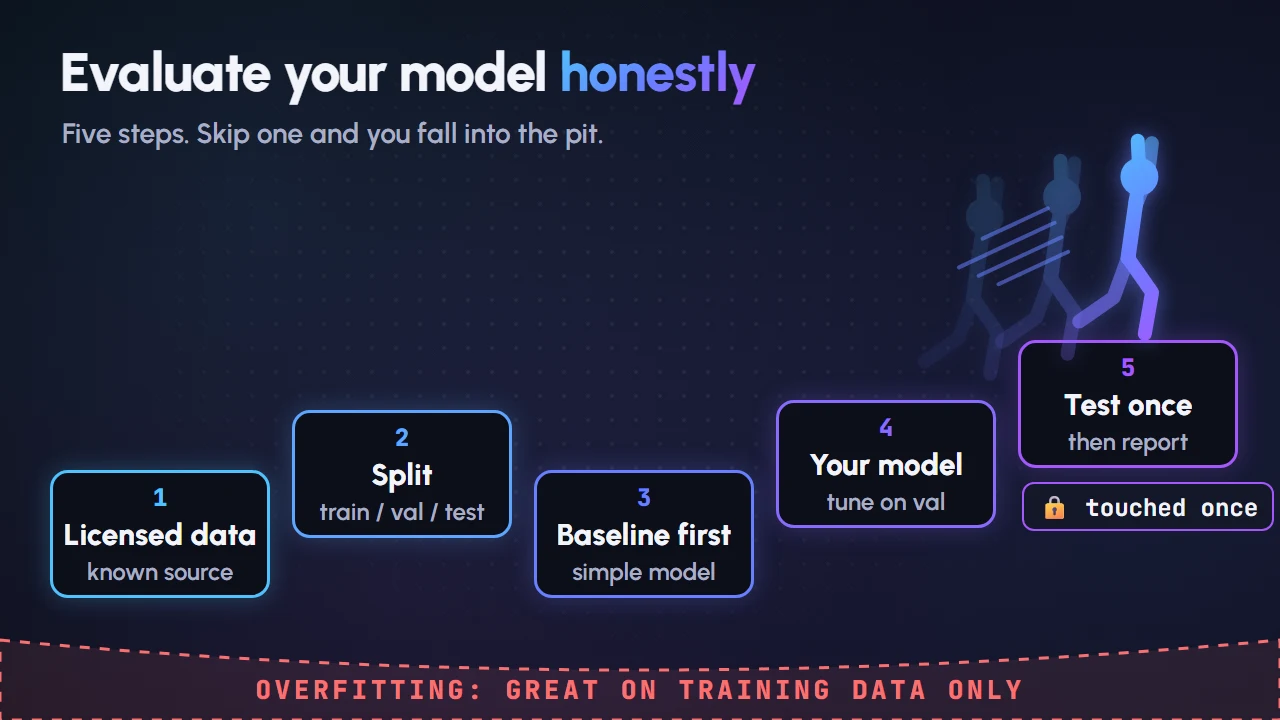
scikit-learn's documentation puts it plainly: testing a model on the data it learned from is "a methodological mistake", because a model that memorised the labels would score perfectly and predict nothing useful (scikit-learn). It also warns that tuning against the test set over and over overfits that too, so keep a separate validation set.
- Classification (sentiment, scam, signs): precision, recall and F1 per class, plus a confusion matrix. Accuracy alone hides a model that ignores the rare class.
- Detection (traffic, helmets, potholes): mAP on your own labelled frames, and counts compared with a manual count.
- Speech: word error rate on speakers who were not in training.
- Forecasting: error against the naive "same as last period" forecast.
- LLM and RAG: a fixed question set with expected answers, groundedness scores, and a written note on the cases where it failed.
End the evaluation chapter with error analysis: twenty examples the model got wrong, and why. That page usually gets more viva questions than the accuracy number.
AI project FAQ
Do I need a GPU for an AI final year project?
Not for most of these. Tabular models, dashboards, RAG over a few hundred documents and small classifiers run on a normal laptop. Fine-tuning vision or speech models needs a GPU for hours, not weeks.
Is calling the ChatGPT or Gemini API enough for an AI FYP?
On its own, usually not. The project is what you build around the model: retrieval, data, tools, guardrails and evaluation. Follow your department's rules on AI use, and be ready to explain every line of your code.
Can I buy a ready-made AI project?
No. Buying or outsourcing an FYP is academic misconduct, and AI projects are especially easy to expose: one question about the training split ends the viva. Get help understanding, then build it yourself.
Once you have two or three candidate ideas, use our guide on how to choose a final year project to pick one, then write it up with the FYP proposal guide.
Key takeaways
- Pick a narrow task with data you can legally use and describe.
- Beat a simple baseline; without one, your accuracy number means nothing.
- Keep a test set the model never sees until the end, and report per-class metrics.
- Urdu and Pashto NLP, local vision data and Pakistani public datasets make your project original and testable with real users.
- Check every licence: CC BY, non-commercial and AGPL each change what you can do later.
- Build the project yourself; never buy one.
Build your AI project with a mentor
Softhat mentors final-year students at our Mardan, Khyber Pakhtunkhwa office or remotely: choosing a dataset, setting up a fair evaluation, structuring the Python code, deploying the demo and practising the viva. You write the code and the report; we help you get them right. See FYP mentorship, or after graduation look at our Python and AI internship and AI automation course.