
- Content Writing
- Social Media Marketing
Urdu and Roman Urdu Content: When and How to Use It in Marketing
When should Pakistani brands use Urdu or Roman Urdu content? A practical guide to channels, copywriting, ad targeting, RTL websites, fonts and hreflang.
 AuthorRehmat Ullah8 min read
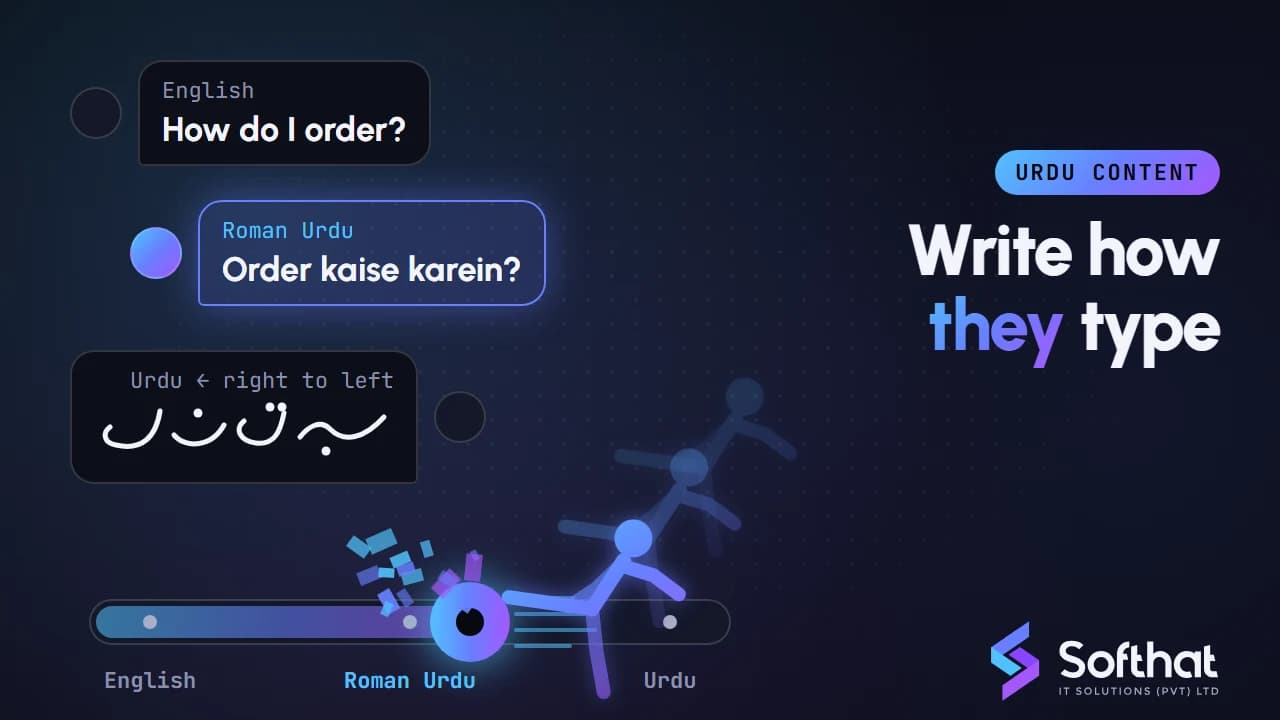
Table of Contents
Scroll through any Pakistani brand's comments section and you will see three languages at once. Some people write in English, some in Urdu script, and many in Roman Urdu: Urdu typed with English letters.
So which one should your marketing use? This guide explains when Urdu and Roman Urdu content makes sense, how to write it well, and the technical details that trip businesses up on ads and websites.
There is no single right answer for every brand. But there is a clear way to decide, test and implement.
Urdu, Roman Urdu and English: what's the difference?
Urdu is written right to left, usually in the Nastaliq style. It is the national language of Pakistan under Article 251 of the Constitution, which also allows English for official purposes.
Roman Urdu is Urdu written in the Latin alphabet: "Aaj hi order karein" instead of the Urdu script. It has no official spelling standard, so the same word is spelled several ways ("hai", "hay", "he").
English remains common in business, education and B2B buying in Pakistan, and many people mix it freely with Urdu in the same sentence.
One useful fact from the Pakistan Bureau of Statistics Census 2023 tables: Urdu is the mother tongue of about 9.25% of Pakistanis. Punjabi, Pashto, Sindhi, Saraiki and other languages account for most of the rest.
That figure counts mother tongue only. It does not measure how many people read or understand Urdu as a second language. So don't use it to judge your Urdu audience size. Use your own data instead, as explained below.
When to use Urdu or Roman Urdu content
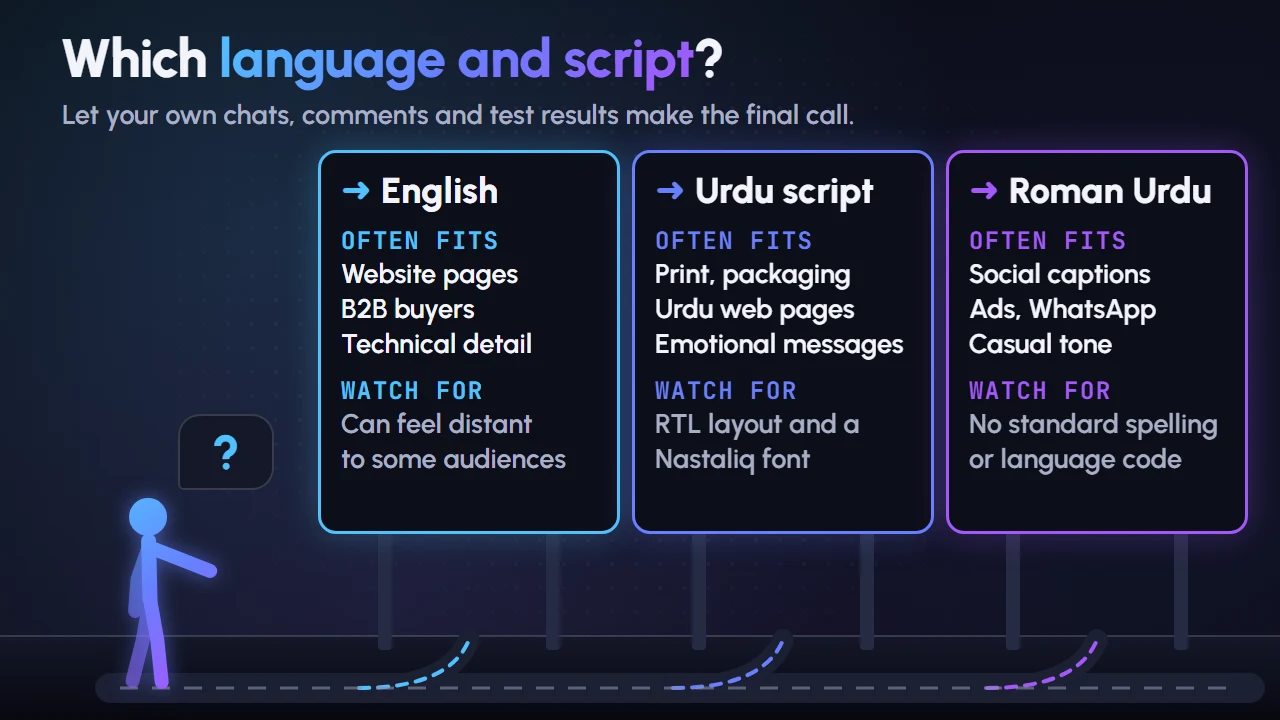
Instead of guessing, look at four signals.
1. How your customers already write to you
Export a sample of your WhatsApp chats, Instagram DMs and Facebook comments. Count how many are in English, Urdu script and Roman Urdu. This is the most reliable evidence you have, because it comes from your own buyers.
2. The channel
| Channel | Typical fit | Why |
|---|---|---|
| WhatsApp messages and broadcasts | Match the customer's language | Conversations feel personal; mirror how they write |
| Instagram and Facebook captions | Roman Urdu, English or a mix | Short, informal text; easy to type and read on phones |
| Short videos and Reels | Spoken Urdu with on-screen captions | Speech carries tone; captions help silent viewers |
| Website service pages | English, with Urdu pages if demand exists | Search, trust and B2B buyers often expect English |
| Print, outdoor, packaging | Urdu script or bilingual | Readable by audiences less comfortable with English |
Treat this table as a hypothesis, not a rule. Your audience data should overrule it.
3. The audience and product
A B2B software company selling to finance teams may do well in English. A home-appliance brand targeting families across Punjab and KPK may connect better with Urdu or Roman Urdu. A regional business may even benefit from Pashto, Sindhi or Punjabi content alongside Urdu.
4. The goal of the content
Emotional, local and conversational messages often suit Urdu. Technical specifications, pricing tables and legal terms are usually clearer in the language your customers use for official documents, which is often English.
How to write Urdu and Roman Urdu copy that works
Good Urdu marketing copy is written, not translated. Direct translation of English slogans often sounds stiff or formal.
Transcreate, don't translate. Start from the idea and the emotion, then write it fresh in Urdu. "Upgrade your kitchen" might become a line about making daily cooking easier for the family, rather than a word-for-word version.
Pick a Roman Urdu style guide and stick to it. Because there's no standard spelling, create a one-page list for your brand:
| Word | Your brand spelling | Avoid |
|---|---|---|
| is / are | hai / hain | hay, hen |
| now | abhi | abi |
| order | order karein | order karen, order kren |
| free | free | muft (unless it suits the tone) |
Keep the register consistent. Decide whether you address customers as "aap" (respectful) or something more casual, and use it everywhere. "Aap" is the safer default for most businesses.
Mix English naturally, not randomly. Many Pakistani audiences code-switch, so product names and common terms like "delivery", "discount" or "online" can stay in English.
Always get a native review. Machine translation tools and AI assistants can produce grammatically odd or culturally awkward Urdu. Have a fluent writer review every headline, ad and CTA.
For planning the wider message, our guide on how to write website copy that converts applies in any language: outcome first, proof, one clear next step.
Urdu and Roman Urdu in ads: targeting implications
Language targeting in ad platforms works on languages, not scripts. That creates a few practical implications.
Google Ads
Google says language targeting reaches people based on the languages they understand, using signals such as the search term language and user settings.
Note the recent change: Google's help page says that starting in September 2026 it is removing the campaign-level language setting for Search campaigns and for the Search placements of Performance Max. Search ads will match based on the language of the ads themselves. Language settings continue to apply to channels like YouTube and Display.
For Roman Urdu this matters. There is no separate "Roman Urdu" language to select, and Google hasn't published how its systems classify Urdu written in Latin letters. So:
- Keep Urdu-script, Roman Urdu and English ads in separate ad groups, so results are easy to compare.
- Check the search terms report to see which queries each version actually served on.
- Don't assume Roman Urdu ads will behave like either English or Urdu ads. Test them.
Meta (Facebook and Instagram)
Meta Ads Manager lets you narrow an audience by language in the ad set settings, and by default it targets all languages in your chosen locations.
Language targeting can't tell a Roman Urdu reader from an Urdu-script reader. In most cases it is simpler to keep language set to all, target by location and interests, and let the creative do the language work. Run the English, Urdu and Roman Urdu versions as separate ads and compare cost per lead, not just clicks.
Adding Urdu content to your website
If your audience research shows real demand, a dedicated Urdu section can help. Get the technical basics right from day one.
1. Set language and direction in the HTML. The W3C advises adding dir="rtl" to the html tag for right-to-left pages, not applying direction with CSS alone. Pair it with lang="ur". Use dir="auto" for form fields where users may type in either script.
2. Use a proper Nastaliq font. Noto Nastaliq Urdu is a free, open-source Nastaliq font on Google Fonts. Nastaliq needs extra line height, so test headings, buttons and menus on real phones before launch.
3. Mirror the layout. Navigation, icons with direction (arrows), breadcrumbs and form labels should flip for RTL pages. Numbers, URLs and brand names stay left to right.
4. Use separate URLs and hreflang. Put Urdu pages at their own URLs, for example /ur/. Google's hreflang format uses an ISO 639-1 language code with an optional region code, so ur or ur-PK for Urdu and en or en-PK for English. Each version must list itself and the others. Our explainer on what hreflang is covers the setup.
5. Don't rely on tags to declare the language. Google states it doesn't use hreflang or the lang attribute to detect a page's language; it uses algorithms. The visible content must genuinely be in Urdu.
What about Roman Urdu pages?
Roman Urdu has no language code of its own. Technically, a script subtag such as ur-Latn is valid in web language tags, and Google's documentation shows script subtags like zh-Hant. But the W3C advises using script subtags only when they are necessary, and Google detects language from the content itself.
Because of that uncertainty, most businesses are better off using Roman Urdu for social media, ads and WhatsApp, and keeping core website pages in English and, where justified, Urdu script.
How to test which language performs
- Start with one campaign. Create the same offer in English, Urdu and Roman Urdu.
- Keep everything else equal: image, budget, audience and landing page.
- Measure the right result: leads, sales or WhatsApp conversations, not just likes.
- Run long enough to collect a meaningful number of results before deciding.
- Document what you learn in your brand guidelines and buyer personas.
FAQ
Is Roman Urdu bad for SEO?
Not inherently, but it is unpredictable. Spellings vary, so people search for the same word in several ways, and there is no dedicated language code. For search-focused pages, English or proper Urdu script is usually easier to plan and measure.
Should I translate my whole website into Urdu?
Only if your data shows demand. Start with the pages that matter most, such as your top service or product pages, and measure results before expanding.
Can I use AI to write Urdu content?
AI can speed up drafts, but quality varies, especially in Nastaliq script and idioms. Always have a fluent human editor check accuracy, tone and cultural fit.
Which language should my WhatsApp replies use?
Mirror the customer. If they write in Roman Urdu, reply in Roman Urdu, keeping your brand's spelling style consistent.
Speak your customers' language, on purpose
Urdu and Roman Urdu content can make your brand feel closer to the people you serve. The businesses that get it right decide based on customer data, write natively instead of translating, and handle the technical details properly.
Need help planning and writing multilingual content? Our content writing team helps brands across Pakistan decide on language, write the copy and set up tests to see what works. Book a free strategy call to talk through your audience.