
- Content Writing
How to Write a Content Brief (Free Template Inside)
Learn how to write a content brief that gets the right article first time. Includes a free copy-paste content brief template for blogs and web pages.
 AuthorRehmat Ullah8 min read
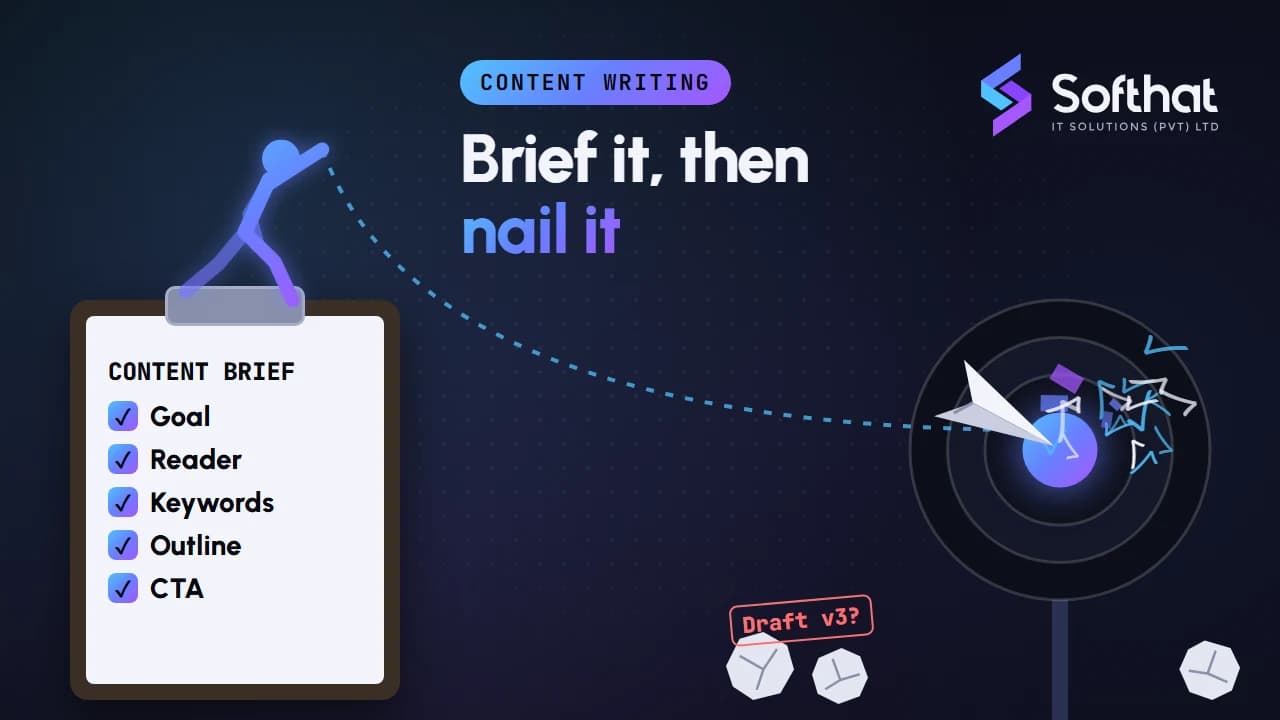
Table of Contents
You asked a writer for "a blog post about our new service". A week later you got 1,500 words that were well written, but aimed at the wrong reader, missing your key points and ending without a call to action.
The writer wasn't the problem. The brief was.
A content brief is a short document that tells a writer exactly what to create, for whom and why. This guide explains how to write one step by step, and gives you a free content brief template you can copy into Google Docs, Notion or an email today.
What is a content brief and why does it matter?
A content brief is the instruction sheet for a piece of content. It captures the decisions that should be made before writing starts: goal, audience, search intent, angle, structure, sources and the action you want readers to take.
Without a brief, those decisions get made by guesswork, and then remade in rounds of revisions. With a good brief, you get:
- Fewer revisions, because expectations are agreed up front.
- Consistent quality across in-house writers, freelancers and agencies.
- Content that supports business goals, not just word counts.
- Better use of research, such as keyword data and customer questions.
Briefs matter even more now that many teams use AI tools for drafting. A vague prompt produces generic content. A precise brief gives both humans and tools the context they need.
What to include in a content brief
Every brief should answer the same core questions. The depth depends on the piece: a short social post needs a few lines, a pillar guide may need two pages.
| Section | Question it answers | Example |
|---|---|---|
| Working title | What is this piece about? | How to Choose a Solar Installer in Pakistan |
| Goal | What should this content achieve? | Generate quote requests from homeowners |
| Audience | Who exactly is reading? | Homeowners comparing installers for the first time |
| Search intent | What does the reader want when they search? | Compare options and avoid costly mistakes |
| Primary and secondary keywords | Which phrases should it target? | "solar installer Pakistan", "net metering" |
| Angle | Why is our version different or better? | Checklist from real installation projects |
| Outline | What sections are required? | H2s with notes on what each must cover |
| Sources and proof | What evidence must be used? | Official regulations, internal project data |
| Internal links | Which pages should it link to? | Service page, related guides |
| CTA | What should the reader do next? | "Get a quote on WhatsApp" |
| Format and length | How long, what style, what visuals? | 1,500 words, one diagram, FAQ section |
| Deadline and owner | Who delivers what, by when? | Draft by 20th, review by marketing lead |
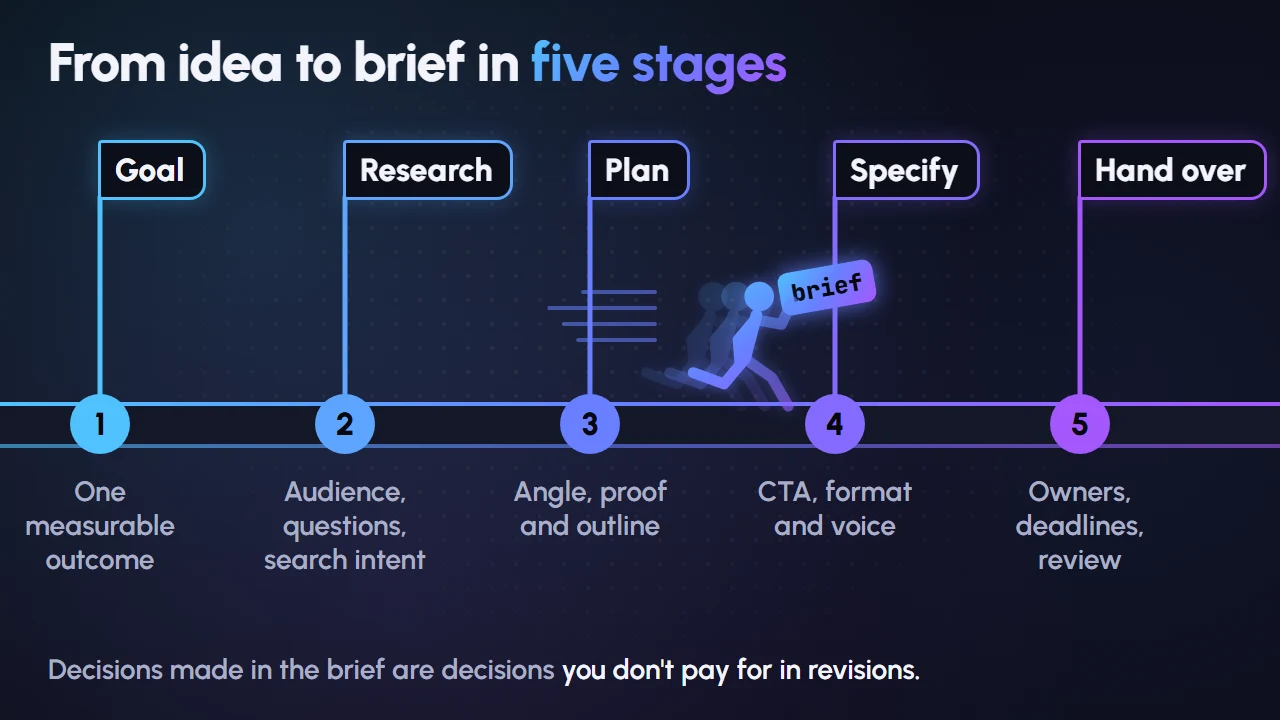
How to write a content brief in 7 steps
Step 1: Start with one business goal
Choose a single primary goal: leads, sales, sign-ups, support deflection or brand awareness. A post that tries to rank, sell, educate beginners and impress experts at once usually does none of those well.
Write the goal as a measurable action: "Readers request a quote" is clearer than "increase engagement".
Step 2: Define the reader precisely
Describe the reader in one or two sentences, including what they already know. "Small business owners" is too broad. "Owners of 5 to 20-person retail businesses who have never run Google Ads" gives the writer something to work with.
If you have buyer personas, link the relevant one. Add real questions from sales calls, WhatsApp chats or comments. They are the best raw material a writer can get.
Step 3: Research search intent and keywords
Search your main keyword on Google and study the top results. Are they guides, product pages, comparisons or tools? That tells you what format searchers expect.
Then note:
- The primary keyword and two to five close variations.
- Questions people ask (from "People also ask", Search Console queries and customer conversations).
- Gaps in current top results that your piece can fill. Our guide to content gap analysis explains how to find them.
Step 4: Define the angle and the proof
This is the section most briefs skip, and the one that separates useful content from copies of what already ranks.
Google's guidance on helpful, people-first content asks whether content provides "original information, reporting, research, or analysis" and adds value beyond other results. Your brief should say where that value comes from:
- First-hand experience or project examples.
- Internal data you are allowed to share.
- An expert inside your company the writer should interview.
- A clear point of view on a debated question.
List required sources too, especially for statistics, laws, prices and platform policies. Ask writers to link to official sources rather than to other blogs. This supports E-E-A-T, Google's framework for experience, expertise, authoritativeness and trust.
Step 5: Build the outline
Give the writer suggested H2 headings and a one-line note on what each section must cover. You don't need to write the article for them. You need to make the must-haves impossible to miss.
Remember how people read online. Nielsen Norman Group found that most users scan web pages rather than reading word by word, so ask for descriptive subheadings, short paragraphs and lists. Our guide on how to write website copy that converts covers this structure in more detail.
Step 6: Set the CTA, format and style
Specify:
- The CTA and the page it links to.
- Length range, for example 1,300 to 1,800 words, based on what the topic needs rather than an arbitrary target.
- Visuals required: screenshots, diagrams, tables.
- Tone and language. Link your brand voice guide. If the piece is in Urdu or Roman Urdu, note spelling conventions (see our guide to Urdu and Roman Urdu content).
- Words and claims to avoid, such as unverifiable superlatives.
Step 7: Agree review and hand-over
Name the writer, the reviewer and the subject expert. Set deadlines for the outline, first draft and final draft. Say how feedback will be given, for example comments in a shared Google Doc.
Free content brief template (copy and paste)
Copy the template below into your document tool. Delete any section that doesn't apply to a small piece.
CONTENT BRIEF

1. BASICS
Working title:
Content type: (blog post / service page / landing page / email / case study)
Owner:                     Writer:                  Reviewer:
Outline due:               Draft due:               Publish date:

2. GOAL
Primary goal (one only):
How we will measure it: (e.g. quote requests, sign-ups, key events in GA4)

3. AUDIENCE
Who is reading (1-2 sentences):
What they already know:
Their top questions or objections:
-
-
-
Persona link (if any):

4. SEARCH
Primary keyword:
Secondary keywords:
Search intent: (learn / compare / buy / solve a problem)
Top-ranking pages reviewed (URLs):
Gaps our piece will fill:

5. ANGLE AND PROOF
Our unique angle:
Experience, data or examples to include:
Expert to interview:
Required sources (official where possible):

6. OUTLINE
H2:        Must cover:
H2:        Must cover:
H2:        Must cover:
H2:        Must cover:
FAQ questions (3-5):

7. LINKS
Internal links (2-4):
External sources to cite:

8. CALL TO ACTION
Primary CTA text:
CTA link:

9. FORMAT AND STYLE
Length range:
Visuals needed:
Tone and brand voice guide:
Language / spelling notes:
Words or claims to avoid:

10. SEO DETAILS
Suggested URL slug:
Meta title (max ~60 characters):
Meta description (max ~155 characters):

11. NOTES FOR THE WRITER
Common content brief mistakes to avoid
- Keyword-only briefs. A keyword and a word count is not a brief. Writers need the goal, reader and angle.
- Too long to read. A 10-page brief for a 1,000-word post gets skimmed. Put essentials first.
- No proof requirements. Without them, writers fill gaps with generic claims or unsourced statistics.
- Missing CTA. Content with no next step leaks readers you worked hard to attract.
- Changing the goal mid-draft. If the goal changes, update the brief first, then the draft.
FAQ
How long should a content brief be?
Usually one to two pages. It should be long enough to remove guesswork, and short enough that the writer reads all of it.
Who should write the content brief?
Typically the content strategist, SEO lead or marketing manager. The best briefs include input from sales or customer support, because they hear customer questions every day.
Can I use a content brief with AI writing tools?
Yes. A detailed brief makes AI drafts far more relevant. Still, a human should check facts, add first-hand experience and edit for your brand voice. Google's guidance also suggests being transparent about how automation was used where readers would reasonably expect it.
Do I need a brief for every piece of content?
For anything that takes more than an hour to create, yes. For quick social posts, a short three-line brief covering goal, audience and CTA is often enough.
Get content that's right the first time
A clear brief is the cheapest way to improve content quality. It saves revision time, keeps writers aligned and makes sure every piece supports a business goal.
If you want a team that builds the brief, does the research and writes the content, our content writing service can take it off your plate. Book a free strategy call and tell us what you need to publish next.