- Careers & Skills
- Final Year Projects
Final Year Project Ideas for IT Students (2026): Web, Networking & Cyber Security
23 final year project ideas for BS IT students: web-based systems, network monitoring, lab-only cyber security, cloud, IT service desk and IoT, with stack and difficulty.
 AuthorRehmat Ullah11 min read
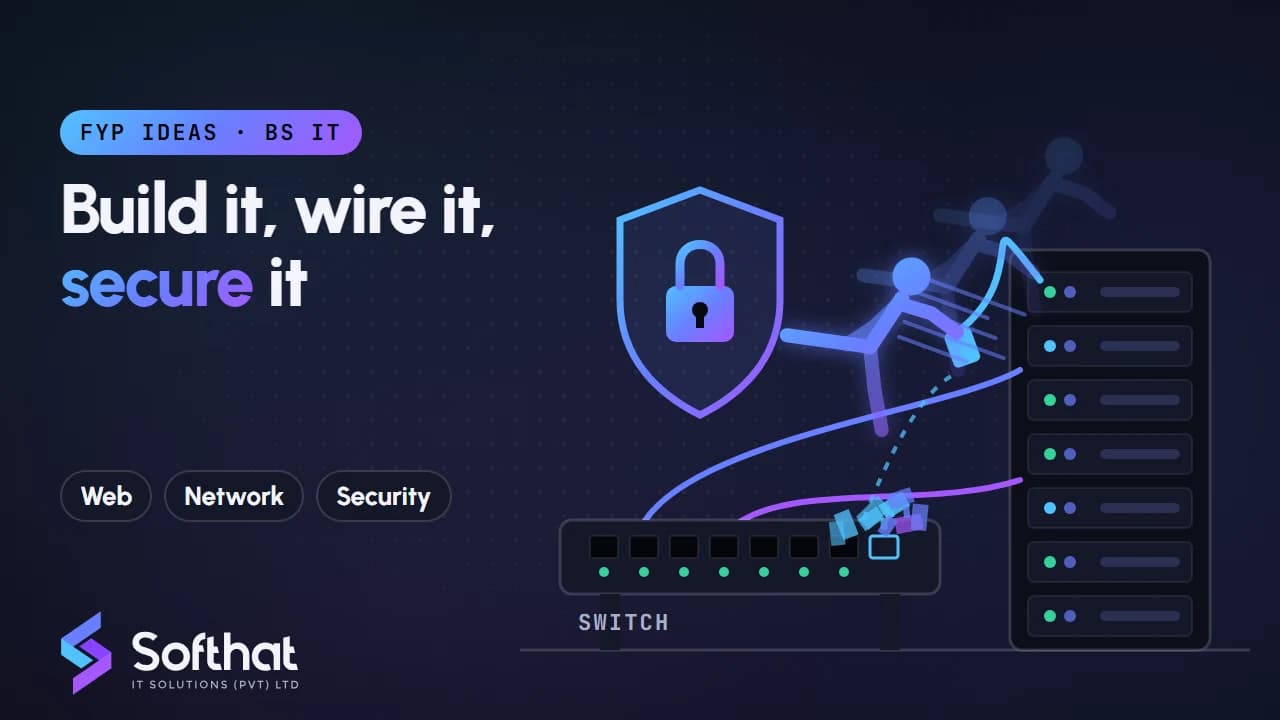
Table of Contents
BS IT students often get handed the same FYP lists as computer science students, full of AI models and research-style problems. Then the supervisor asks what the project has to do with information technology.
An IT project is judged differently. Examiners want to see systems that fit together: a web application on a real server, a network you can see and measure, security you can show working, and something an IT department could actually run on Monday morning.
This list gives 23 final year project ideas built for that brief, across six tracks: web-based systems, networking and monitoring, cyber security, cloud, IT service desk and IoT. Each comes with what it does, a stack and an honest difficulty rating. For AI-heavy and general software ideas, see our main list of final year project ideas for computer science, our AI and machine learning project ideas and the FYP ideas for software engineering.
What makes an IT final year project different
An IT final year project is about integration, operation and security: taking existing tools, protocols and services and making them work together reliably for a real organisation.
Three things usually score well with IT examiners:
- It runs somewhere real. A server, a VM, a cloud instance or a lab network, not only
localhost. - It can be measured. Uptime, response time, alerts raised, tickets closed, attacks detected in a test.
- It is secured and documented. Who can log in, how data is backed up, what happens when something fails.
Your department decides what counts as enough scope for an IT FYP. Some accept a well-documented network design; others want a software component in every project. Ask your coordinator early, and if you are still deciding, read how to choose a final year project first.
Web-based final year project ideas
Web-based projects are the easiest to demo and deploy. For IT, give each one a clear operational side: roles, logs, backups and HTTPS through a free certificate from Let's Encrypt.
- 1. Hostel allocation and mess billing portal. Students apply for rooms, the warden allocates them, and monthly mess bills and dues are tracked per student. Stack: Laravel or Django, MySQL, PDF receipts. Difficulty: easy to medium.
- 2. Lab equipment booking and inventory. Staff book projectors, lab PCs and kits; each item has a QR label, an issue history and a "due back" reminder. Stack: Next.js or Laravel, Postgres, a QR library. Difficulty: easy to medium.
- 3. Alumni and placement portal. Graduates keep their profiles current, employers post openings, and the department sees where each batch ended up. Stack: any web framework, role-based access, email notifications. Difficulty: easy.
- 4. Website health auditor. You enter a list of your organisation's own sites; it runs performance and accessibility checks on a schedule and emails a report when scores drop. Stack: Node, Lighthouse, a job scheduler, a dashboard. Difficulty: medium.
If you want to build web projects properly before your final year starts, our web development course covers the stack.
Networking and monitoring ideas
Networking projects show you understand how a real organisation's infrastructure fits together. The software part is usually the monitoring, automation or reporting built on top.
- 5. Campus network monitoring dashboard. Watches switches, routers and servers, graphs bandwidth and uptime, and alerts the IT team when a link goes down. Stack: Zabbix, or Prometheus with Grafana, SNMP. Difficulty: medium.
- 6. Campus network design and simulation. A complete design for a department or small university: VLANs, routing, access control lists, Wi-Fi and addressing, built and tested in a simulator. Stack: Cisco Packet Tracer, available through Cisco Networking Academy. Difficulty: easy to medium. Pair it with idea 7 if your department expects a software component.
- 7. Network configuration backup and change tracker. Pulls router and switch configs over SSH every night, stores them in Git and alerts on any unexpected change. Stack: Python, Netmiko, Git, a small web viewer. Difficulty: medium.
- 8. Wi-Fi coverage survey app. Staff walk a building with a phone or laptop; the app records signal strength per room and draws a coverage heatmap over the floor plan. Stack: Python or Flutter, a floor-plan image, heatmap plotting. Difficulty: medium.
Cyber security final year project ideas (lab-only)
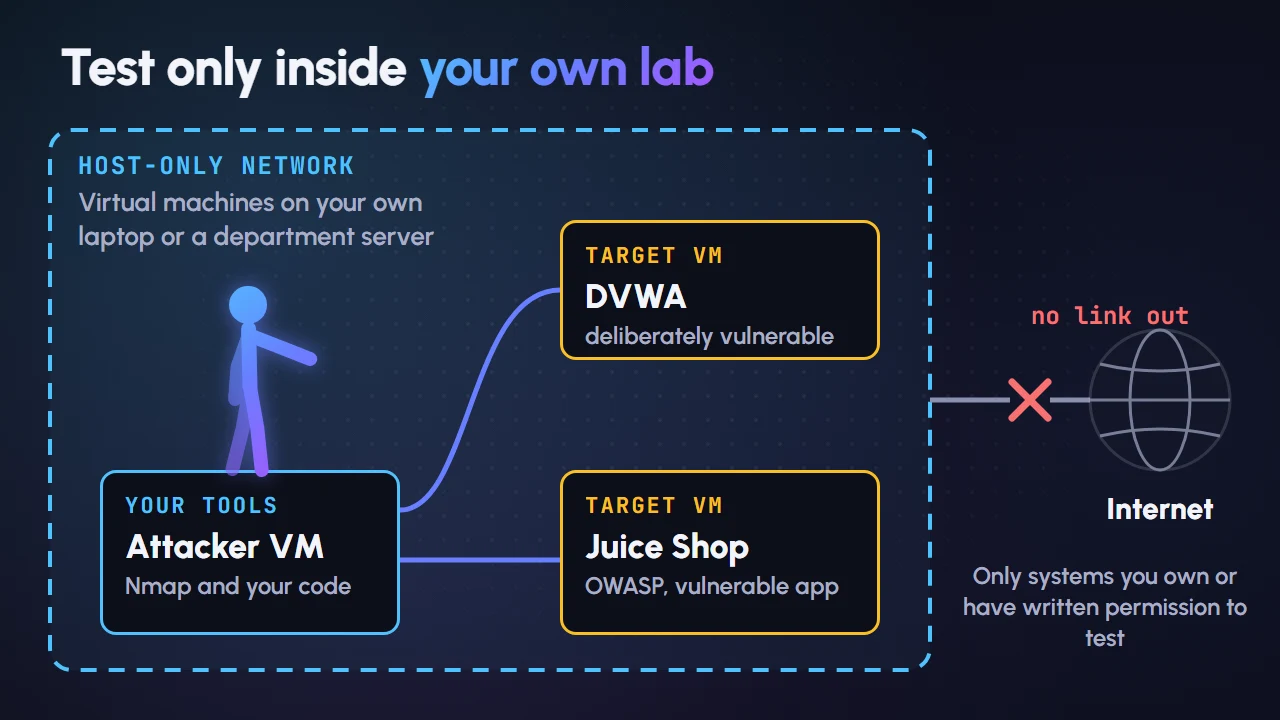
Cyber security projects are popular, and they carry one rule that is not negotiable: you test only systems you own or have written permission to test. Build a lab of virtual machines on your own laptop or a department server and keep every attack inside it. The legal section below explains why.
- 9. Phishing awareness trainer. A training platform that sends simulated phishing emails to consenting volunteers in a lab, shows a lesson page when someone clicks, and reports click rates per group. The landing page must never collect real passwords. Stack: Gophish (open source) or your own Flask app, a local mail server, a lesson built on CISA's phishing warning signs. Difficulty: medium.
- 10. Log analyser and mini SIEM. Collects SSH, web server and Windows logs from lab machines, detects brute-force logins and port scans, and raises alerts on a dashboard. Stack: Python, Elasticsearch or Postgres, or extend Wazuh, which is free and open source. Difficulty: medium to hard.
- 11. Vulnerability scanner for your own lab. Scans lab VMs for open ports and service versions, matches them against known vulnerabilities and produces a report with fixes. Stack: Python wrapping Nmap, deliberately vulnerable targets such as DVWA and OWASP Juice Shop in VMs on a host-only network. Difficulty: hard.
- 12. Password policy and breach checker. Checks new passwords against a policy and against known breached passwords without ever sending the password itself, using the Pwned Passwords range API, which works on partial hashes. Stack: any web framework, SHA-1 hashing. Difficulty: easy.
- 13. Attack-and-fix web app study. Build a small web app, attack it in your lab using the categories in the OWASP Top 10:2025, fix each flaw and document the before and after. Stack: your web stack of choice, Burp Suite Community or OWASP ZAP. Difficulty: medium.
- 14. File integrity monitor for an office server. Alerts when important files or configs change unexpectedly and keeps a tamper-evident log. Stack: Python, hashing, a scheduler, email or WhatsApp alerts. Difficulty: easy to medium.
Cloud and DevOps ideas
Cloud projects show you can deploy and keep a system running, which is exactly what employers hire IT graduates to do. Azure for Students gives full-time students $100 of credit with no credit card (Microsoft Azure).
- 15. Office server to cloud migration. Move a small office's existing app and database from a local PC to a cloud VM, with a written migration plan, a rollback plan, HTTPS and a before-and-after comparison of uptime and access. Stack: a cloud VM, Docker Compose, Nginx, Let's Encrypt. Difficulty: medium.
- 16. Backup and restore verifier. Backs up an office's databases and files on a schedule, then actually restores them into a test machine and reports whether the restore worked. Stack: shell or Python, cloud object storage, a status dashboard. Difficulty: medium.
- 17. Private file sharing for an office. Replace USB drives and personal email with a self-hosted file server: user accounts, shared folders per team, access rights and an audit of who opened what. Stack: Nextcloud (open source) on a VM, LDAP or local accounts, documented backup. Difficulty: easy.
IT service desk and operations ideas
Every organisation with more than a handful of computers needs someone to track IT problems, accounts and equipment. These ideas are practical, and your own department's IT office is a ready test user.
- 18. Help desk ticketing with SLAs and an asset register. Staff raise tickets by web or email, each ticket has a priority and a response deadline, and every laptop and printer has a history of its issues. Stack: Laravel or Django, email parsing, role-based access. Difficulty: medium.
- 19. Staff onboarding and offboarding checklist. When someone joins, the system creates their accounts from a checklist; when they leave, it lists every access to revoke and records when each was done. Stack: web app, integrations with email and file-sharing admin APIs where available. Difficulty: medium.
- 20. Device inventory agent. A small agent on each office PC reports hardware, OS version, free disk space and pending updates to a central dashboard. Stack: Python or Go agent, REST API, a web dashboard. Difficulty: medium to hard.
IoT-lite ideas
IT projects can include hardware without becoming electronics projects. Keep the hardware simple and put the effort into the network, the data and the alerts. Eclipse Mosquitto is a lightweight open source MQTT broker that suits all of these.
- 21. Server room temperature and power alert. A Raspberry Pi with a sensor watches the server room and sends an alert when it gets too hot or the power fails. Stack: Raspberry Pi, MQTT, a dashboard, SMS or WhatsApp alerts. Difficulty: easy to medium.
- 22. RFID lab access log. Students tap a card to enter a lab; the system logs who was there and when, and the lab in-charge sees usage per day. Stack: an RFID reader, a microcontroller or Raspberry Pi, a web dashboard. Difficulty: easy to medium.
- 23. Water tank level monitor. Tracks the water level in a hostel or office tank and alerts before it runs dry or overflows. Stack: an ultrasonic sensor, MQTT, a phone-friendly dashboard. Difficulty: easy.
IT project ideas by track and difficulty
Choose the track you want to work in after graduation, then pick the difficulty that suits your team. A medium project that works end to end beats a hard one that is half done.
| Track | Easy | Medium | Hard |
|---|---|---|---|
| Web-based systems | 1, 2, 3 | 4 | |
| Networking and monitoring | 6 | 5, 7, 8 | |
| Cyber security (lab-only) | 12, 14 | 9, 13 | 10, 11 |
| Cloud and DevOps | 17 | 15, 16 | |
| IT service desk | 18, 19 | 20 | |
| IoT-lite | 21, 22, 23 |
Ideas rated "easy to medium" sit in the easy column, and "medium to hard" in the hard column; your scope decides which end you land at.
To make any of these stronger, combine two: a help desk (18) fed by the network monitor's alerts (5), or private file sharing (17) whose backups are checked by the restore verifier (16).
Ethics and the law for security projects
Testing a system without permission is a crime in Pakistan, even if you mean well. The Prevention of Electronic Crimes Act, 2016 makes it an offence to gain unauthorised access to an information system or data, to copy or transmit data without authorisation, and to interfere with a system, all with dishonest intention (sections 3, 4 and 5). It also covers misuse of another person's identity information and unauthorised interception (sections 14 and 17) (National Assembly of Pakistan, PECA 2016). The Act has been amended since, so check the current text for anything beyond this summary.
What that means for your project:
- Test only your own lab or systems you have written permission to test. Nmap's own guide advises getting written authorisation before scanning any network you do not administer (Nmap Network Scanning).
- Keep vulnerable apps off the internet. DVWA's documentation warns that putting it on an internet-facing server will get that server compromised.
- Phishing simulations need consent from the participants and approval from your supervisor, and must never capture real credentials.
- Do not capture other people's traffic. Use Wireshark on your own lab network, not on the campus Wi-Fi.
- Write a short ethics section in your proposal that lists the lab setup and the permissions you have. Supervisors look for it.
IT FYP ideas FAQ
Is a network design project enough for an IT FYP?
It depends on your department. Some accept a well-documented design and simulation; others expect a software component as well. Ask your FYP coordinator, and if in doubt, add a monitoring or automation tool on top, as in ideas 5 and 7.
Can I do a cyber security FYP without a powerful laptop?
Yes. Lightweight targets such as DVWA run in a small VM, and ideas 12 and 14 need almost no lab at all. Ask your department whether a lab server is available for heavier work.
Which ideas help me get an IT job in Pakistan?
Ideas that match day-to-day IT work: monitoring (5), help desk (18), deployment (15) and backups (16). Employers can see you have run real systems, which is what our internships look for too.
Can I buy a ready-made IT project?
No. Buying or outsourcing an FYP is academic misconduct, and examiners find out in the viva when you cannot explain your own configuration. Get guidance, then build and configure it yourself.
Key takeaways
- IT projects are judged on integration, operation and security, not on how novel the algorithm is.
- Deploy on something real: a server, a VM, a cloud instance or a lab network.
- Measure what your system does: uptime, alerts, response times, tickets closed.
- Keep every cyber security test inside your own lab; PECA 2016 makes unauthorised access an offence.
- Combine two medium ideas rather than starting one hard idea you cannot finish.
- Confirm scope and format with your department, and never buy or outsource the project.
Get mentorship for your IT final year project
Softhat mentors final-year students at our Mardan, Khyber Pakhtunkhwa office or remotely: scoping the idea, setting up a safe lab, architecture, deployment, weekly reviews, documentation and viva practice. You build and configure the project yourself; we review, question and guide. See FYP mentorship, and once you have picked an idea, turn it into a plan with our FYP proposal guide.