
- AI & Automation
AI Lead Qualification: Respond Faster and Focus on Buyers
How AI lead qualification helps Pakistani businesses reply to leads in seconds, ask the right questions and route real buyers to sales, with setup steps.
 AuthorRehmat Ullah7 min read
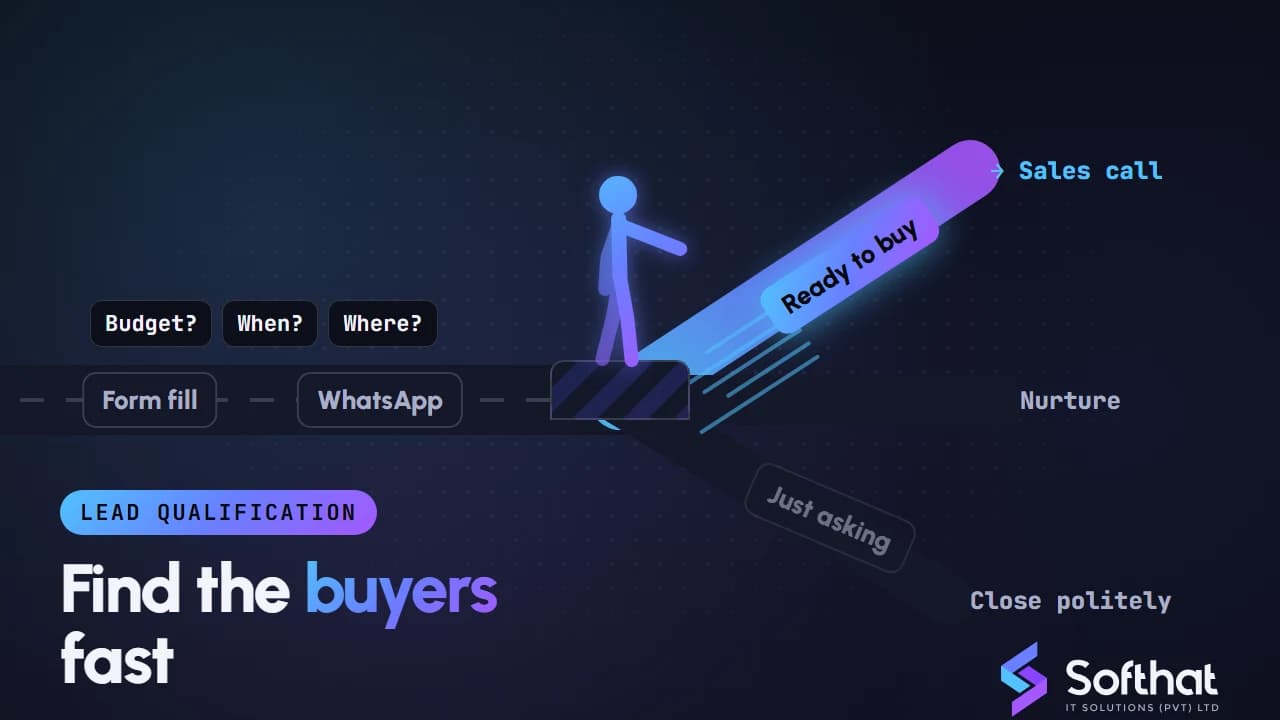
Table of Contents
You pay for every lead. A Facebook form fill, a Google Ads call, a WhatsApp message from an Instagram post. Then the lead sits in an inbox until someone has time, and by evening the buyer has already spoken to a competitor.
AI lead qualification fixes the gap between a lead arriving and a salesperson talking to them. An AI assistant replies within seconds, asks a few smart questions, scores the answers and sends serious buyers straight to your team.
This guide explains why speed matters so much, what to ask, how scoring works and how to set it up without annoying the people you want to sell to.
Why response speed decides who wins the lead
The research on this is old but still widely cited. In a study published in Harvard Business Review, researchers analyzed 1.25 million sales leads at 42 US companies. Firms that tried to contact a lead within an hour were nearly seven times as likely to qualify it as those that waited even an hour longer, and more than 60 times as likely as those that waited 24 hours or more.
The same authors audited 2,241 US companies and found that 23% never responded to a web lead at all.
That research is from the US, but the principle is easy to see in Pakistan too. When a customer is comparing three solar installers or four property agents on WhatsApp, a slow reply gives the others a head start.
The trouble is that fast replies are hard for a small sales team. People sleep, go to meetings and take Friday prayers. An AI assistant does not.
What AI lead qualification actually does
Lead qualification means working out whether a lead is likely to buy, and how soon. Traditionally, a salesperson does this on the first call. AI takes over the first few minutes of that job.
A typical AI qualification assistant:
- Replies instantly on the channel the lead used: WhatsApp, website chat, Instagram or a form follow-up.
- Asks three to five qualifying questions in natural conversation, in English, Urdu or Roman Urdu.
- Understands free-text answers, such as "budget around 15 lakh" or "need it before Ramadan".
- Scores the lead based on your rules.
- Routes the lead: book a call, alert a salesperson, send information or close politely.
- Logs everything in your CRM (customer relationship management system) or a shared sheet.
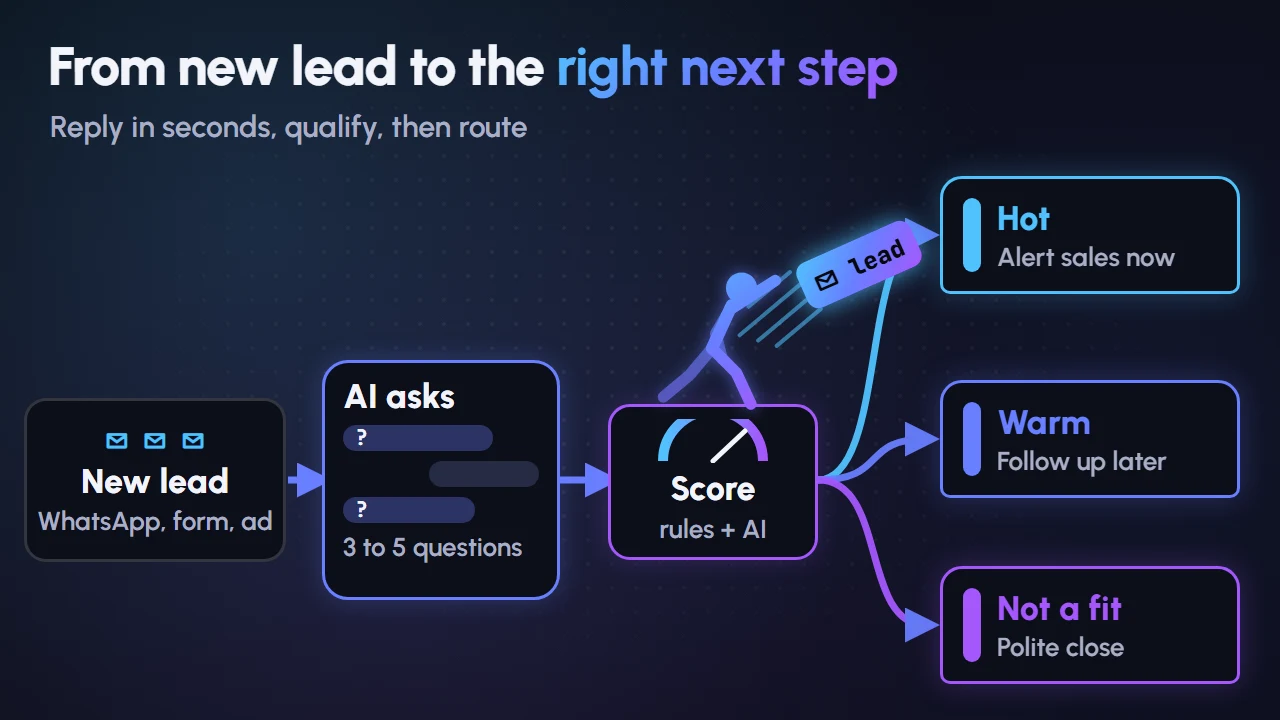
It does not replace your salespeople. It makes sure they spend their day on buyers instead of chasing people who wanted a free price list.
Choosing the right qualifying questions
The questions matter more than the AI model. Many teams use a simple framework like BANT: budget, authority, need and timing. Adapt it to how your customers buy.
Questions that work across industries
- Need: "What are you looking for help with?"
- Timing: "When are you hoping to start or buy?"
- Budget: "Do you have a budget range in mind?" Offer ranges as buttons, because many people will not type a number.
- Authority: "Will anyone else be involved in the decision?"
- Location: "Which city are you in?" This matters for delivery, site visits and service areas.
Examples by business type
| Business | Useful qualifying questions |
|---|---|
| Real estate | Buy or rent, area, budget range, move-in timeline |
| Solar installer | Monthly bill, roof type, city, own or rented home |
| Education or training | Course interest, current qualification, start date, online or onsite |
| B2B services | Company size, current solution, decision timeline, role |
| Clinic or salon | Treatment, preferred date and time, first visit or returning |
Keep it short. Three to five questions is plenty. If a lead has to answer ten, many will stop replying.
How lead scoring works
Scoring turns answers into a decision. You can start simply.
Rule-based scoring
Give points for each answer that signals intent. For example, a timeline of "this month" might earn more points than "just exploring", and a budget within your range more than one far below it. Add the points and set thresholds for hot, warm and cold.
Rules are transparent and easy to adjust. They suit most small and mid-sized businesses.
AI-assisted scoring
An AI model can also read the whole conversation and judge intent from tone and detail. A lead who asks about installation dates and payment plans is showing more intent than one who asks "price?" and goes quiet.
The safest approach combines both: rules for clear criteria, and AI to flag signals the rules miss. Always let your sales team see why a lead received its score.
Routing each score
- Hot: alert a salesperson immediately and offer the lead a call slot.
- Warm: send useful information, such as a brochure or case example, and schedule a follow-up.
- Cold or not a fit: thank them politely and point them to a better option if one exists.
A polite "not a fit" still protects your reputation. That person may refer a friend who is.
Setting up AI lead qualification step by step
- Map where leads come from: Meta lead forms, Click to WhatsApp ads, Google Ads, website forms, phone calls and walk-ins.
- Agree the definition of a qualified lead with sales. Write it down.
- Write your three to five questions and the scoring rules.
- Choose the channel. For many Pakistani businesses, WhatsApp is the natural place for the conversation.
- Build the assistant and connect it to your CRM or sheet, and to calendar booking if you use it.
- Set up alerts for hot leads by WhatsApp, email or your CRM.
- Test with your own team using realistic, messy answers.
- Launch on one lead source first, compare results for a few weeks, then expand.
If your leads come from paid ads, the source matters for both cost and quality. Our comparison of Meta Ads vs Google Ads covers how lead intent differs between the two.
WhatsApp rules to respect
If you qualify leads on WhatsApp through the Business Platform, a few rules apply.
- Opt-in: WhatsApp's policy allows businesses to contact people only if they have shared their number and given opt-in permission. A lead who messages you first has started the conversation. A number from a form needs clear consent for WhatsApp follow-ups.
- Escalation: the same policy requires "prompt, clear, and direct escalation paths" when you use automation. Let leads ask for a person at any point.
- Pricing: since October 2026, Meta charges for service messages sent inside the 24-hour customer service window. A tight question flow keeps costs down.
- Ads bonus: leads from Click to WhatsApp ads open a 72-hour free entry point window when you reply within 24 hours, which suits qualification conversations.
The same design principles apply to support bots; our guide on automating customer support with AI covers handoffs in more depth.
Mistakes that cost you good leads
- Interrogating people. Too many questions, or questions that feel like a form, make leads drop off.
- Asking for budget first. Build a little trust before asking about money.
- No human option. Some buyers want to talk to a person immediately. Let them.
- Hot-lead alerts nobody sees. Instant qualification is wasted if the salesperson checks the CRM once a day.
- Scoring nobody reviews. Compare scores with actual sales every month and adjust.
- Ignoring language. Test Urdu, Roman Urdu and mixed messages, not just English.
Frequently asked questions
Does AI lead qualification work for B2B?
Yes. B2B leads often need questions about company size, role and timeline, and the assistant should book a call quickly for anyone who fits. Knowing your ideal customer helps; see our guide to creating buyer personas.
Will leads know they are talking to AI?
They should. Say clearly that an assistant is collecting a few details for the team. Being open builds more trust than pretending, and most people only care about getting a fast, useful reply.
What if the AI scores a good lead as cold?
That can happen, which is why cold leads should still receive a polite reply and information, and why sales should review scoring regularly. Start with conservative rules and tighten them once you see real results.
What does it cost to set up?
Costs depend on the channel, the number of lead sources, CRM integration and message volume. A simple WhatsApp qualification flow costs much less to build than a multi-channel system with calendar booking and custom scoring.
Turn more of your leads into sales conversations
AI lead qualification gives every lead a fast, helpful first reply and gives your sales team a clear list of who to call first. The businesses that benefit most start small, measure honestly and keep a person close to the process.
Softhat builds AI lead qualification and automation, connected to your CRM, that qualify leads and hand them to your team in real time. Book a free strategy call and we will map your lead sources and qualifying questions with you.