

- AI & Automation
- Digital Marketing
Which Parts of Your Business Should AI Run? A One-Hour Audit
A practical one-hour audit for Pakistani businesses: list your repeated tasks, score them, and decide what to automate, what to simplify and what to leave alone.
 AuthorRehmat Ullah7 min read
Table of Contents
Most automation projects fail for a boring reason: nobody wrote down what the business actually does all day. A tool gets bought, a workflow gets built, and six weeks later everyone is back to WhatsApp and a register.
This audit fixes that. It takes about an hour, needs nothing but a pen, and ends with a short list of the tasks worth automating first, in your business, in the order that pays back soonest.
Do it before you buy anything.
Step 1: List what actually repeats (20 minutes)
Write down every task that happens more than five times a week. Be specific. "Customer service" is not a task; "replying to price questions on WhatsApp" is.
Walk through a normal day from opening to closing, and include the work nobody counts: chasing suppliers, retyping the same quotation, writing the daily sales figure in a notebook, answering the same direction question, reminding a customer who forgot.
Aim for fifteen to thirty lines. Most businesses find more than they expected.
Step 2: Score each task (15 minutes)
Give every task three scores from 1 to 5.
| Score | Question | 1 means | 5 means |
|---|---|---|---|
| Volume | How often does it happen? | Once a week | Dozens of times a day |
| Sameness | How identical is it each time? | Every case is different | Word for word the same |
| Cost of delay | What happens if it is late? | Nothing much | You lose the sale |
Multiply the three. Anything scoring 45 or more is a strong candidate. Anything under 20 is usually not worth building, however annoying it feels.
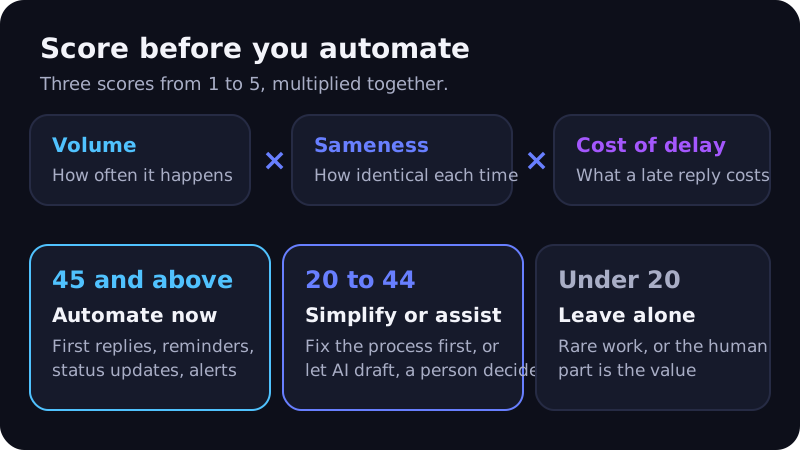
The scoring matters because instinct misleads. The task that irritates the owner most is often rare. The task that quietly loses money is usually the one everybody stopped noticing.
Step 3: Sort into four buckets (10 minutes)
| Bucket | What it looks like | What to do |
|---|---|---|
| Automate now | High volume, highly repetitive, costly when late | Build it first: first replies, reminders, status updates, alerts |
| Simplify first | Repetitive but messy, with exceptions everywhere | Fix the process, then automate the simplified version |
| Assist, don't replace | Valuable, varied, needs judgement | Use AI to draft, summarise or sort; a person decides |
| Leave alone | Rare, or the human part is the value | Do nothing. This is a real answer |
The "simplify first" bucket is where money is usually wasted. Automating a broken process gives you a faster broken process and a maintenance bill.
Step 4: Check you have the raw material (10 minutes)
Automation needs somewhere to read from and write to. For each "automate now" task, ask:
- Where does the information start? A WhatsApp message, a form, a phone call, a delivery slip.
- Where does it need to end up? A sheet, a database, an accounting tool, a person's phone.
- Who owns the accounts involved? Your business must own its WhatsApp number, Google accounts, ad accounts and website. If a supplier holds them, fix that before building anything on top.
- Is the data written down at all? If phone orders exist only in conversation, the first automation is recording them, not processing them.
A task that starts and ends in someone's head cannot be automated yet. It can be made visible, which is step one anyway.
Step 5: Pick exactly one thing and build it (5 minutes to decide)
One. Not a plan for eleven.
Choose the highest-scoring task in "automate now" whose information already exists in writing. Give it two weeks. Write down the number you expect to change: replies within five minutes, missed appointments per week, hours spent on quotations.
At the end of two weeks, compare. If it moved, do the next one. If it did not, you learned something cheap, which is the point of starting with one.
A worked example
A private academy in Khyber Pakhtunkhwa, three staff, admissions season approaching.
| Task | Volume | Sameness | Cost of delay | Score | Bucket |
|---|---|---|---|---|---|
| Answering "fees kitni hai" on WhatsApp | 5 | 5 | 4 | 100 | Automate now |
| Sending the prospectus | 4 | 5 | 3 | 60 | Automate now |
| Reminding registered students about the test date | 3 | 5 | 5 | 75 | Automate now |
| Counselling an undecided parent | 3 | 1 | 4 | 12 | Leave alone |
| Preparing the weekly attendance report | 2 | 4 | 2 | 16 | Simplify first |
They automated the first reply with fees, timings and location, plus a prospectus link, and a test-date reminder. Counselling stayed with the principal, which is where the actual decision gets made. That is the shape of a good result: the repetitive load goes, the human part gets more time.
Common mistakes this audit prevents
- Buying a tool before knowing the task. The tool then decides your process, which is backwards.
- Automating the loudest complaint instead of the biggest cost. Scoring settles that argument.
- Starting with the hardest thing. Complex projects stall, and stalled projects kill appetite for the easy wins.
- Ignoring who owns the accounts. Automation built on someone else's accounts is a hostage, not an asset.
- Skipping the measurement. Without a before-number, "it feels better" is all you will ever have.
What it costs to get this wrong
Two failures show up again and again, and both are avoidable at the audit stage.
The abandoned tool. A business signs up for a platform, builds one flow, then nobody maintains it. Six months later customers are getting replies about an offer that ended, or worse, a bot answers and no human ever follows. Automation needs an owner inside the business, even if an agency built it.
The silent leak. A form stops sending, an integration expires, a WhatsApp number gets disconnected from the platform. Enquiries keep arriving and nobody notices, because nothing visibly breaks. Every automation needs a check: a weekly test message, an alert when nothing has arrived for a day, or a simple count someone actually reads.
Both are cheaper to prevent than to discover three months later from a customer who says "I messaged you twice".
Doing the audit with your team
If you have staff, do this with them rather than for them.
- Ask each person to list their own repeated tasks before you show them yours. They know where the time goes.
- Score together. Disagreement about "sameness" usually reveals an undocumented exception worth knowing about.
- Say plainly what automation is for. People assume it means job cuts. In small businesses it usually means the same team handling more customers without working later.
- Let the person who does the task test the automation. They will find the cases you forgot within an hour.
Frequently asked questions
Do I need AI for this, or just automation?
Most of the "automate now" bucket is ordinary automation: rules, templates, schedules. AI helps where language is messy, such as understanding Roman Urdu enquiries, summarising, or sorting messages by intent. Start with the rules and add AI where rules break down. More detail in AI automation for Mardan businesses.
How long does a first automation take to build?
A WhatsApp first reply or an enquiry alert is usually days. Bookings, quotations or stock flows take one to three weeks depending on what they connect to.
What if my business runs on paper?
Then the first project is getting one process into writing: orders, enquiries or appointments. Paper is not a failure, but nothing downstream can be automated until the information exists in a form software can read.
Can I run this audit myself?
Yes, and you should. Bring the completed list to whoever builds it; the conversation gets much shorter and the quotation much more accurate.
Key takeaways
- Write down every task that repeats more than five times a week before considering any tool.
- Score each on volume, sameness and cost of delay, then multiply: 45 or more is worth automating.
- Fix messy processes before automating them; otherwise you buy a faster version of the same mess.
- Confirm the information exists in writing and that your business owns the accounts involved.
- Build one automation, measure one number for two weeks, then decide on the next.
Bring your list, we will tell you what is worth building
Run the audit, then send us the top three. We will tell you which are worth automating, which need the process fixed first, and which to leave alone. See WhatsApp bots and AI automation or email info@softhat.pk.