- SEO
Google AI Overviews: What They Mean for Your SEO
Google AI Overviews and AI Mode are changing search in Pakistan. Learn how inclusion works, what to optimize and how to track results in Search Console.
 AuthorRehmat Ullah8 min read
Table of Contents
Search a detailed question on Google today and you will often see an AI-written summary above the usual links. These are Google AI Overviews, and they change how people find and click on websites.
For Pakistani business owners, the big question is simple. Does this help or hurt your SEO (getting found on Google)? This guide explains how AI Overviews and AI Mode work, what Google actually asks of site owners, and how to measure the impact in Search Console.
What are AI Overviews and AI Mode?
Google runs two main generative AI features in Search. They look similar, but they serve different kinds of searches.
AI Overviews are short summaries that appear at the top of some results pages. Google says they help people "get to the gist of a complicated topic or question more quickly" and provide a jumping-off point to explore links (Google Search Central).
AI Mode is a separate, conversational search experience. It is designed for questions that need "further exploration, reasoning, or complex comparisons", and it returns a longer AI response with links to supporting websites (Google Search Central).
| AI Overviews | AI Mode | |
|---|---|---|
| Where it appears | Top of a normal results page | Its own tab or mode in Search |
| When it appears | Only when Google judges it adds value | When the user chooses AI Mode |
| Best suited to | Quick answers to complex questions | Multi-step research and comparisons |
| Links to websites | Yes, supporting links | Yes, supporting links |
Google also notes that AI Overviews "often don't trigger", because they only show when its systems decide the summary is additive to classic Search (Google Search Central).
Are they available in Pakistan?
Yes. In May 2025 Google expanded AI Overviews to more than 200 countries and territories and over 40 languages, with support added for languages including Urdu (Google blog).
AI Mode launched in Pakistan in English in August 2025, on the Google app and on mobile and desktop web (ProPakistani). Google later expanded AI Mode to more than 35 new languages (Google blog). Check the current language options on your own device, as rollouts vary.
How Google chooses the links it shows
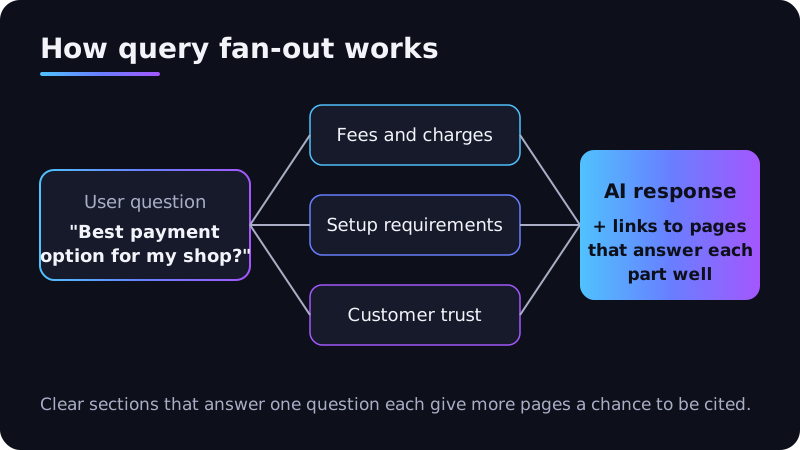
Both features can use a technique Google calls query fan-out. The system runs several related searches across subtopics and data sources, then builds one response from what it finds (Google Search Central).
In practice, this means one customer question can pull in pages that answer different parts of it. A page that clearly covers one subtopic well has a chance to be cited, even if it would not rank first for the main query.
Google also says AI Overviews and AI Mode "may use different models and techniques", so the links shown in each can differ (Google Search Central).
Google AI Overviews and SEO: what Google actually requires
Here is the most useful sentence in Google's documentation: "There are no additional requirements to appear in AI Overviews or AI Mode, nor other special optimizations necessary" (Google Search Central).
To be eligible as a supporting link, a page must be indexed and eligible to be shown in Google Search with a snippet. Google adds that you do not need new machine-readable files, "AI text files" or special schema.org markup to appear.
So be careful with anyone selling a secret "AI Overview optimization" package. The foundations are the same ones that already drive organic rankings.
The SEO basics Google lists
Google's own list of fundamentals that still matter for AI features includes (Google Search Central):
- Allow crawling in robots.txt and in your CDN or hosting setup.
- Make content easy to find through internal links.
- Provide a good page experience.
- Put important content in text form, not only in images.
- Support text with high-quality images and videos where useful.
- Make sure structured data matches the visible text on the page.
- Keep Merchant Center and Business Profile information up to date.
If any of these feel unfamiliar, start with our guides on crawlability and schema markup.
What to optimize: a practical plan
Knowing there is no special trick is freeing. Your effort goes into things that help both classic rankings and AI citations.
1. Write unique, non-commodity content
In its May 2025 guidance, Google advised site owners to focus on "unique, non-commodity content" that people find helpful, noting that users in AI search ask "longer and more specific questions" (Google Search Central Blog).
Generic definitions are easy for AI to summarize without a click. First-hand detail is not. For a Pakistani business, that could mean:
- Local pricing factors, delivery areas and lead times.
- Real process steps from your own projects.
- Answers to the exact questions your sales team hears on WhatsApp.
- Clear comparisons that help a buyer decide.
Showing real experience also supports E-E-A-T, Google's framework for experience, expertise, authoritativeness and trust.
2. Structure pages so each section answers one question
Because of query fan-out, clear sections help. Use descriptive H2 and H3 headings, answer the question in the first sentence under each heading, then add detail.
Tables, numbered steps and short FAQs make it easier for both people and systems to find the specific answer they need.
3. Fix page experience and technical access
Google says pages should work well across devices, load with low latency and make the main content easy to distinguish from everything else (Google Search Central Blog).
It also reminds site owners that Googlebot must not be blocked and that pages should return an HTTP 200 (success) status code. Slow, cluttered mobile pages are still common on Pakistani business sites, so this is often the quickest win. Our guide to Core Web Vitals is a good place to start.
4. Go beyond text
People can now search with a photo and ask a question about it. Google recommends supporting your text with high-quality images and videos, and keeping Merchant Center and Business Profile details current (Google Search Central Blog).
For shops and local service businesses, an accurate Google Business Profile with correct hours, phone number and photos matters more than ever.
How to track AI Overviews in Search Console
Measurement has improved a lot in 2026. There are now two places to look.
The Performance report
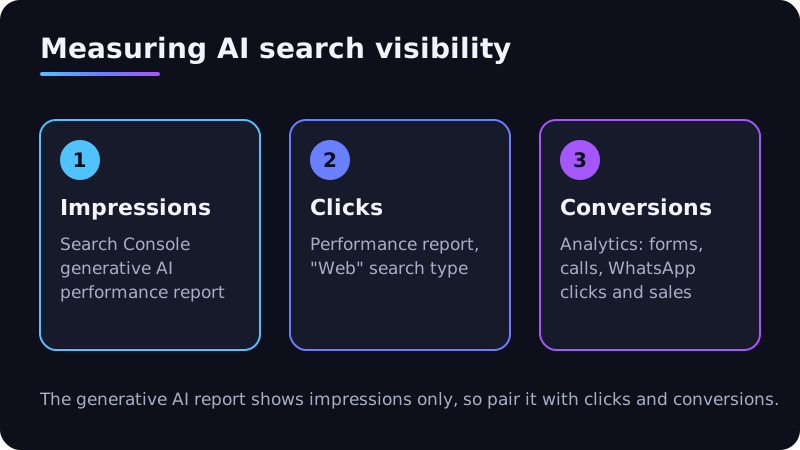
Traffic from AI Overviews and AI Mode is counted in your overall Search Console data, within the Web search type of the Performance report (Google Search Central). This is where you see clicks.
The new generative AI performance report
On 3 June 2026, Google announced dedicated Search Generative AI performance reports in Search Console. As of 31 August 2026, they have rolled out to all websites worldwide (Google Search Central Blog).
The report shows:
- Impressions: how often your URLs appeared in generative AI features.
- Pages: which URLs appeared.
- Countries and devices.
- Dates, from hourly to monthly.
Google's help page confirms it covers AI Overviews and AI Mode, and that several results from your site shown together count as one impression (Search Console Help). Note that the report currently shows impressions only, not clicks. Sites with too few AI impressions may not see data yet.
Measure value, not just clicks
Google says clicks from results pages with AI Overviews are "higher quality", meaning users are more likely to spend more time on the site (Google Search Central). Treat that as Google's claim and test it on your own data.
In Google Analytics, track the actions that pay the bills: form submissions, WhatsApp clicks, calls and sales. A small drop in clicks with a rise in enquiries is a good trade.
Can you opt out of AI Overviews?
You can, but think carefully before you do.
Search Console now has a Search generative AI control under Settings. It lets you include (the default) or exclude your site's links and content from AI Overviews, AI Mode and generative AI features in Discover. Google states the control "isn't used as a ranking or inclusion signal affecting other parts of Search" (Search Console Help).
Other options still exist. The nosnippet, data-nosnippet, max-snippet and noindex controls limit what Google shows from your pages. Google-Extended is a separate control for limiting AI training and grounding in some of Google's other systems (Google Search Central).
For most businesses that want leads, staying included is the sensible default. Opting out removes you from a growing part of the results page while competitors stay visible.
Key takeaways
- AI Overviews and AI Mode are live in Pakistan, and AI Overviews support Urdu.
- There is no special markup or file needed. Pages must be indexed and snippet-eligible.
- Unique, experience-based content with clear sections improves your chances of being cited.
- Page experience, crawl access and accurate Business Profile data still matter.
- Use the new generative AI report for impressions, the Performance report for clicks and analytics for conversions.
- The new Search Console opt-out does not affect classic rankings, but opting out means giving up visibility.
Get your site ready for AI search
AI search rewards businesses that already do the fundamentals well. If you are unsure whether your site is crawlable, fast and genuinely useful, an audit is the right first step.
Our SEO services team can review your pages, fix technical gaps and build content that earns citations and enquiries. Book a free strategy call to get started.